For only the second time in my life, I crossed the Equator and visited another developing country, the great nation of Peru. I am also from a developing country, so I knew what to expect. My travel mates, my wife included, were not, so many things that were surprising to them, were just mundane to me. Peru’s economy is about one tenth the size of India’s but its per capita GDP is about triple that of India’s. In a practical sense, the average Peruvian citizen is in better economic shape than the average Indian, however, extreme poverty exists in both countries. As you can probably guess, my reference point is the Great Nation of Bharat, Peace be Upon It. India ceased to exist in 2014, hence I shall not identify with that sullied nation. You can also tell that the average Peruvian is better behaved than the average citizen of Bharat because the Peruvian passport is actually worth something, unlike the Most Holy Passport of Bharat, which is worth less than the literal paper on which it is printed. Peruvian currency notes, however, have the same cheap feel to them as do the Most Prosperous currency notes in Bharat. The difference is that Peruvian currency is actually designed in a sensible way, portraying the country’s symbolism, history, flora and fauna. Bharatiya banknotes, meanwhile, look like monopoly money, all of them feature the same man, a bunch of overly detailed monuments on the back, and even government propaganda. Traffic in Peru is much like that in Bharat, where traffic suggestions are routinely ignored. There exists a precarious impasse between vehicles and pedestrians, where the rules are unwritten and eternally changing, much like the 24 Tirthankaras of the Jain cosmic cycle, and you never know which one is current. Peru should seriously consider replacing all traffic signals in the country with the ancient Indian symbol of the Ashoka Chakra, lighting each spoke in succession, to indicate the prevailing traffic suggestions.
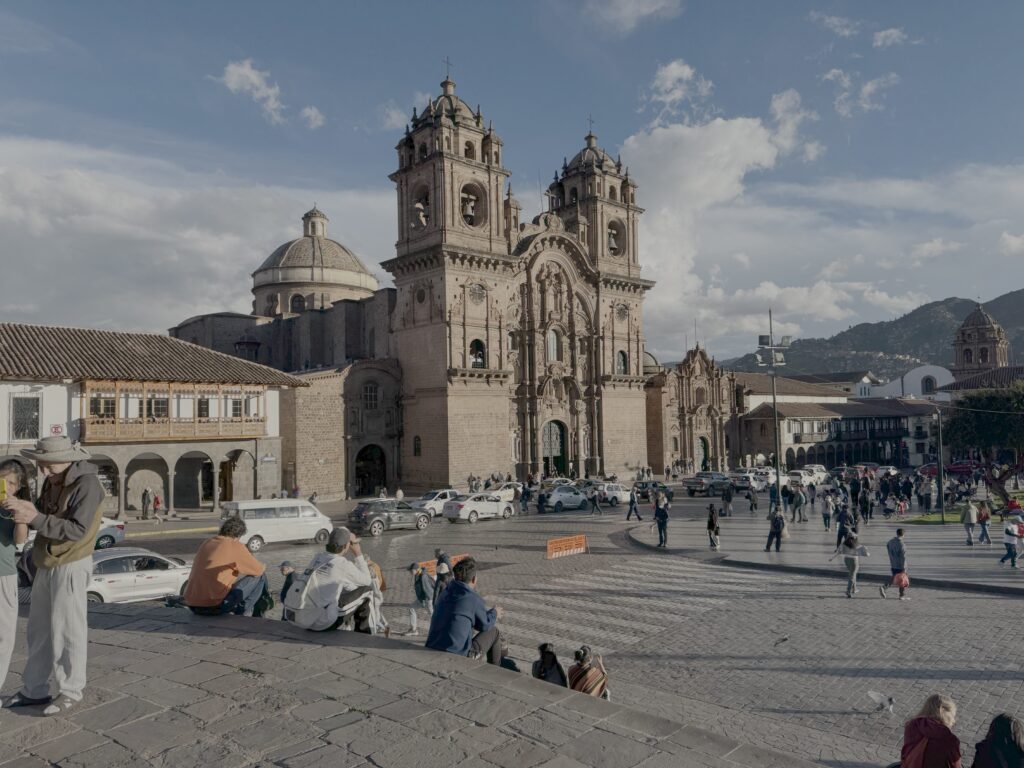
We visited Cusco and Lima, in that order, arriving first in the three-kilometre-high “navel of the world”, also known as Qusqu in Quechua. Right from the start, I knew this was not a developed country. The lady at immigration took one look at the name on my passport, saw a vaguely Iberian name, and started speaking Portuguese to me. Now, if she had spoken to me in Spanish, that would have been normal. No. Instead, she assumed I was from Brazil and was then confused when I told her I was Indian, from India. The real India, not the fake one that White people found and decided to mislabel as the “West” India. Cusco airport is tiny, roughly the same size as our local Home Hardware in Guelph. So tiny, that waiting inside the literal gate of immigration, are local taxi drivers, preying on unsuspecting tourists like vultures. Where else would you find that? Bharat, of course.
Outside, I noticed that many buildings in Cusco were visibly incomplete, with the underlying bricks clearly visible. I still wonder why, however, that visual is very similar to a certain Vishwaguru, sometimes known as Hindustan. The cars on the road were reminiscent of the Arabian Gulf in the 1990s and I distinctly remember seeing several Toyota Corollas on the road, identical to the one my dad drove back in Bahrain. The stench from the car engines was also terrible, in fact, worse than Bharat. In Mumbai, the baseline level of pollution is relatively high, so it is possible that my nose just blended vehicle exhaust into the background, but in Peru, diesel engines were everywhere and they made the roads stink. I am eternally grateful that emissions standards in Canada continue to be high, despite the copious wastage of fuel in lifted pickup trucks for insecure men. On a more positive note, I noticed that almost every vehicle in Cusco was practical. Some had high ground clearance because the highways were uneven. Some had space for six passengers, because they were actually carrying six passengers. Some had large beds, but were designed in a practical way that enabled easy loading and unloading. Most vehicles were Japanese, Korean or Brazilian and that brought me joy. I was happy to see that the infestation of “sports” utility vehicles and general car obesity had not arrived.
Of course, Peru is a predominantly Catholic country, so Jesus is everywhere. No thanks to the Spanish, who spread the gospel of the Lord Jesus Christ with demonic fervour. The Spanish were so evil, that they committed wholesale rape, loot and plunder of the natives, actions that are closer to those committed by literal demons in Hell, as opposed to the self-proclaimed messengers of Christ. The good news is that just like in Indonesia and India, the native culture survived and is today thriving. Some museums in Cusco make this point well, but not well enough. Europeans deserve to know just how brutal these supposed “men of god” actually were, and modern Europeans should feel ashamed of these actions, not responsibility, but shame.
More to come.