Canada, like anything in real life, is complicated. There are things I like, things I tolerate, things I enjoy, and things I despise.
Warning – Coarse language.
Vehicle obesity
I am not a person driven to extreme opinions and I am often willing to meet people where they are. On one subject in particular, I am an extremist, a missionary, a jihadi, even. That is auto obesity.
The top ten best-selling vehicles in Canada in 2024 were pickup trucks and SUVs. These are vehicles that are needlessly large, impractical, inefficient, but immensely profitable for the American automakers. I tend to view most US residents as gullible, low information yokels, but the capitalists who run the United States are the literal exact opposite. Opposite to the point of evil, and the auto industry is the perfect example. Look under the hood of one of these monstrosities and you will find plenty of empty space. Space that does literally nothing. The US automakers spent billions of dollars in market research and lobbying efforts to make this nonsense legal. Empty space so cars can look more aggressive, manly, and, intimidating. The space inside cars means that the occupants are safer, and motor vehicle mortality data shows this clearly. However, that comes at the expense of people outside these fucking SUVs and “light” trucks.
This is so bad, that Canada is one of only seven countries to see an increase in pedestrian fatalities. One among the others is the United States. The CBC found that some of the most aggressive drivers tend to drive more expensive cars, lending credence to the belief that these drivers are assholes. The #1 selling vehicle in Canada is the Ford F-series pickup truck, ostensibly used by the hard-working, rural Canadians who work in the trades and regularly use the four-wheel drive system to negotiate unploughed snowy roads. Fuck no. These suburban assault vehicles are driven by Brad and Becky, mostly on grocery runs and while carting their progeny to and from “sports”. US data from Edward’s shows that three quarters of US pickup truck drivers tow something once a year or never. More bluntly, these vehicles are almost never used for their purported purpose. That is about as absurd as seeing Justin Trudeau walking around 24/7 in ski gear because he loves skiing. These vehicles are idiotic devices, sold to gullible consumers, all with the goal of signalling virtue. The size of your pickup determines how much of a man you are. The spacers you put on the wheels signal to women that you have a long penis, of great girth. Funny, how the lack of pickup trucks in India and China does not affect their reproductive abilities. This obsession with size and “practicality” is so pervasive that I’ve seen Punjabi and Tamil Canadians driving around in these monstrosities. Brampton and Scarborough have black pickups with AK decals on the back. Some even have the flag of the LTTE. It is absolutely wild seeing Diljeet and Thushaan joining this ass-backwards trend.
If you are a politician reading this and can promise me that you will mandate commercial licenses for any vehicle with a height over 2 meters, I will vote for you. I will even allow you a little racism and homophobia if you reduce the number of pedestrian deaths, especially via cunts like this man, who killed the mother of an infant with his morbidly obese pickup truck.
Road signs
Canadian roads have signs, just like any civilized country. Canadian roads, though, swing between extremes. On one end, you have places like Toronto and Montreal, where you need advanced degrees in mathematics to determine whether or not parking is legal at a certain time. On the other, you have long stretches of rural highways with scant signage, sometimes to the point where the cops exploit that fact to issue fines. Some of these signs are at head height, around 1.5 meters above ground level. I often wonder how many people have smacked their heads into the signs or have been left bleeding after colliding with them edge-on.
The nature
People from around the world come to Canada to experience the great outdoors. And great they are. The provinces and the federal government operate a world-class system of parks and nature reserves. I highly recommend visiting them because they truly are a sight to behold. The pride extends deep and I’ve seen brown immigrants picking up random bits of trash so as not to spoil the experience for the next person. Around 22 million people visited the federal parks in 2023 and around 12 million visited the Ontario parks system in 2024. These parks are popular. So popular that the camping and parking reservation websites are regularly swamped.
In Spring 2025, I bought an electric car. The clutch in my old Ford Focus was on the verge of disintegration. The Americans, clever as always, stopped manufacturing “small” cars and now focus exclusively on suburban assault vehicles like SUVs and pickup trucks, driven by suburban owners of assault rifles and connoisseurs of freedom. A Marxo-socio-communist like me has no option other than to buy a bulbous “crossover” vehicle. These vehicles combine the impracticality of SUVs with the small footprint of a sedan car, producing a true combination of the worst of both worlds. Ah, the American auto industry, truly the most intelligent people on the planet.
Anyhow, I now drive a 2022 Hyundai Kona EV. It is very cheap to operate and has slashed our petrol spending by 88%. It has buttons, knobs, glass mirrors and is for all practical purposes, just a normal car. I repeat, it is just a car that you drive. There are, however, several niggles that I do not like.
One obvious difference is in the weight of the car. My old Ford focus weighed around one tonne. This Kona weighs around 2.2 tonnes. The difference in inertia is instantly obvious when braking. The EV takes longer to slow down and the brakes are very aggressive. Something to be aware of, but something that familiarity will fix.
I like to watch the heads of my passengers as I drive. The forward and backward movement of their heads is a reliable indicator of how much acceleration is happening and I like to minimize acceleration. This means changing speed slowly and consistently. In a combustion car, if you accelerate to highway speeds and then idle the engine, friction makes the car decelerate, but slowly. You can bring the car to a complete stop from 120 km/h in about 200 meters. This is safe and comfortable. In our Hyundai, if you stop accelerating, the car starts braking. This is the action of the regenerative brakes and I appreciate their ability to capture wasted energy. Comfortable, however, they are not. Traffic speed constantly changes and sometimes, you want to stop accelerating but not start braking. You want to coast. That is not easy to achieve in a Hyundai EV. Yes, you can disable the auto regen braking but it has an annoying tendency of turning itself back on. This means that your passengers are quite uncomfortable after a while of constantly swapping between braking and accelerating.
On the plus side, Hyundai’s adaptive cruise control is very adept at varying engine power to reduce speed and maintain a safe distance to the vehicle ahead. Varying engine power via the accelerator pedal is not as easy.
On the negative side, cruise control also enables lane detection, which, isn’t always the best. I learned to drive in the Netherlands where skidding on wet and icy roads is a risk. You learn how to drive using a racing line, not for speed, but for safety. Put simply, your car’s tires have finite grip. Changing speed or direction uses grip. In slippery or wet conditions, your aim is to keep the car moving as straight as possible, while also planning for the worst. The racing line starts on the outside curve of a lane, moves to the inside apex and then returns to the outside. You never drive beyond the lane limit. If there is ice, it tends to accumulate on the inside of a banked turn. If your car is already pointing where you want it to go, losing grip on the inside of a turn is less dangerous, you just keep moving ahead safely. Hyundai’s lane assist system will not allow this. It keeps beeping and bonging that the car is too close to the lane edge. Oh and many exits on Ontario highways do not have marked exit lanes. Instead, the right lane becomes wider, with one side becoming the exit ramp. My car keeps trying to force me to exit. You cannot disable lane assist in my car and there is no speed-only mode for the cruise control. Both are linked.
Hyundai’s “crossover” design for the Kona means that the car is higher than it should be, and so is the hood of the car. In that additional height, is a great big void so the additional height is purely for cosmetic reasons. My strong preference is to not drive into pedestrians, especially children. To maximise front visibility, I use a booster seat. My head now touches the roof of the car and I cannot adjust the rear view mirror at this height. Obviously, this is also a problem if you are tall.
Hyundai’s software for the car includes scheduled charging, allowing you to minimize your charging costs. This works well. What does not work well is Hyundai’s scheduled departure feature, which is supposed to heat or cool the cabin in anticipation of a fixed departure time. Bizarrely, the scheduled heating/cooling only works if the car is still charging when the departure time arrives. This means that if you depart at 07:00 in the morning and your car just happens to finish charging at 03:00, the departure time is meaningless because the heating/cooling will not run.
The car includes a liquid cooled battery but there is no way to turn on battery preconditioning. If you are on a road trip, you want the battery temperature to be around 20 C for peak charging speeds, which are already low on a budget car. There is no way to do this. A software update should fix it, but alas. Hyundai appear to be infected by American capitalism.
The car’s software is also full of beeps and bongs. So many that they are actively irritating and occasionally a safety hazard. Sometimes, the cruise control disengages. That’s a bong. If you use your turn signal in anticipation of a turn and there happens to be a car next to you, that’s a series of beeps. If the outdoor temperature drops to zero Celsius, that’s a bong. If the car ahead of you turns onto a side road, the car’s collision avoidance system thinks that a collision is imminent. That’s a series of bongs. Sometimes, if you brake too hard, the car chides you for dangerous driving. That’s a bong. This is a cultural thing and is evident on other Korean-designed devices like Samsung’s phones, also full of beeps and bongs. I have to try very hard to not train myself to ignore these sounds.
To be clear, I love an electric car. It does take some getting used to but, nothing time cannot fix. Hyundai have some cultural quirks and some capitalist quirks but give the state of the car market in 2025, I can live with those. I highly recommend the Hyundai Kona, especially if you can find one used.
I use AI regularly. At work, I use AI as a sort of supercharged Wikipedia. I’m always careful to verify what it tells me. I always ask whether a response is plausible. Generally, I’m working with things that I understand, even if not fully.
I spend some time every week on a website called Hacker News. This is a group of software bros (mostly) talking about things that interest them. Often, it includes people from google, apple, and farcebook – the people building the AI machines. We are about two years into the AI hype cycle and the advantages of AI are often sold as making people more productive. Productivity is a loaded word and it means different things in the software world as it does to me. My productivity is higher when I can access a translation tool that captures intent instead of translating every word by itself. A software developer’s productivity is higher when they can write more code quickly and verify that it is high quality code. There’s one other application that comes up often – vibe coding. Essentially, using English language prompts to generate code. Basically, you describe what you want to do and the AI machine conjures up the code to achieve that goal. The point here is that it raises the floor. People who have a problem, know the steps to solve it but are unable to translate that into code can now create that code with LLMs.
I wanted to know whether my electricity bill was as low as it could be. The province of Ontario introduced a new electricity rate called the ultra-low overnight (ULO) plan. It gives you access to dirt cheap electricity rates between 11 PM and 7 AM. The catch, however, is that between 4 PM and 9 PM. Now, my wife’s commute is long. Long enough that we were spending $ 400 per month on petrol. We still spend on fuel, but around $ 50 per month on electricity. Since I am Indian, I wondered if I could reduce our bill even further with the ULO electricity rates. Could I?
One way to answer this question is to download my electricity date from my utilities’ website and to then do some maths. I could do this but it is annoying. Instead, I decided to vibe code my way out of this problem. I do know how to write HTML, I know what CSS is and I know how to build a webpage to do this. But I could not be arsed to do all of it. Why bother when the machine could possibly do it for me? That was exactly what I did and I was surprised by the results. The HTML file I eventually built worked, but it was not without some dangers.
Here was the prompt I typed into Microsoft’s Copilot:
Write html code. This code allows the user to upload a CSV file showing hourly electrical energy usage.
Create a series of 48 sliders. The first 24 show average energy consumption for weekdays. The second 24 show hourly energy consumption for weekends i.e. saturdays and sundays. All sliders should be modifiable by the user. Sliders are named by hour i.e. starting at 01:00, ending at 24:00.
The first column has dates formatted as yyyy-mm-dd. The remaining columns are the electrical energy consumption by hour. Hours start at 01:00 and end at 24:00.
First, add a column at the end. convert the date into a day of the week. Filter rows by weekdays. For each column, calculate the average energy consumption for that hour. Assign the value of each weekday column average to the corresponding weekday slider. repeat for all hours of weekdays.
This gave me code that worked, but I ran into a couple of problems. First, the CSV file from my utility did not work and the code I had provided no hints as to why. I also had no idea how to debug HTML. Ok, so I uploaded an example file to Copilot. It told me that the CSV file was comma separated but the code assumed it was separated by spaces. Ok, the AI fixed that.
Next, I noticed that the hourly average energy consumption was off. Every single calculation was off. Ok, now I asked the machine to create two tables at the bottom, showing the dates, the corresponding date of the week, the hourly energy values and the averages at the bottom. Great, but now the days of the week were all one behind? The first of May 2025 was a Wednesday. This table showed it as a Tuesday? I asked the AI machine and apparently, these dates were processed as a date-time in UTC, and then converted to my local time. Since I live in the Eastern time zone in North America, all days of the week were one day behind. Ok, the machine fixed that as well. Now I had average hourly energy calculations that were correct.
Great. I next added calculation logic for the energy calculation. I pointed the machine to the OEB website with electricity plans and rates. For some reason, the machine used the correct time blocks for electricity rates, but the wrong rates (in cents / kWh). No matter, I had a text box where I could input the rates.
There were a series of other errors as well, all of which I fixed. For each of these, I refined the calculation logic. The AI machine, however, gave me code that would not work. The calculation logic used an if…elseif construct. The start is always with an if statement. The code snippets that Copilot gave me always started with an elseif block. If I did not know that this was a problem, my HTML code would not work and I would have no idea why. It is possible that the machine would eventually notice but I cannot be sure. After all, the machine wrote the initial code and then lost track of what it was modifying. Very often, the code snippets included extra braces and brackets. Again, something I knew how to fix.
In all, my experience was excellent. I spent about five hours of a weekend wrangling Copilot and Google Gemini. Time well spent because I would never have produced this much code in five hours. I do not fully understand the code I have, but I verified at least one calculation and it is correct. The other calculations are plausible so I have more faith in them. AI is excellent at this but it requires some basic competence with writing and debugging code. Producing code that is correct also requires specific knowledge, in my case, what a reasonable electricity bill looks like. Someone without this knowledge would never have spotted the errors that I did. Should the average person use LLMs to write code? Absolutely, but please verify, else you have no idea what your code does or how it works. Will I continue to use LLMs to write code? Absolutely and I will expand my uses of it. I will likely write excel macros and automate some tedious tasks on my computer, such as editing photos.
<script>function calculateCost() {constmodel=document.getElementById('pricingModel').value;lettotalCost=0;letcostDetails='';constweekdayAverages=weekdayData.map(arr=>arr.length ?arr.reduce((a,b)=>a+b) /arr.length :0);constweekendAverages=weekendData.map(arr=>arr.length ?arr.reduce((a,b)=>a+b) /arr.length :0);constallHours= [...weekdayAverages,...weekendAverages];constmonthlyHours=allHours.map(val=>val*4); // scale to monthly//very often, the LLM would tell me to update this if block, //but it would start the block with an elseif//and a misplaced braceif (model==='tou') { const season=document.getElementById('touSeason').value; const off=parseFloat(document.getElementById('touOffPeak').value) /100; const mid=parseFloat(document.getElementById('touMidPeak').value) /100; const on=parseFloat(document.getElementById('touOnPeak').value) /100; let weekdayTOU={off:0,mid:0,on:0}; let weekendTOU={off:0,mid:0,on:0};// Calculate average TOU energy for one weekdayfor(leth=0; h < 24; h++){constval=weekdayAverages[h];if (season==='summer') {if (h>=11&&h<17) weekdayTOU.on+=val;elseif ((h>=7&&h<11) || (h>=17&&h<19)) weekdayTOU.mid+=val;elseweekdayTOU.off+=val;
If you live in Ontario, Canada, the electricity regulator – the Ontario Energy Board – sets
your electricity rates and plans
. Electricity rates are based on two factors – how much electricity you use, and/or when you use it.
Each electricity plan offers different options for both factors. You have three options in 2025 – tiered rates,
time-of-use rates and the newest option – the Ultra-low overnight rate (ULO). The ULO rate could be cheapest
if you own an electric vehicle and drive a lot. The exact EV usage amount when the ULO rate is cheapest depends
on how much you drive and your charging requirements, i.e. when you need to charge your car. Most of my charging
is overnight and the ULO rate offers a significantly cheaper option for this period. However, the ULO rates include
periods during the evening when electricity rates are higher.
What this page does:
Use this page to estimate the cheapest electricity billing option for you. You must
provide at least one week of electricity usage data in a CSV file. The calculations below
use your hourly energy usage to calculate two typical days of electricity usage – a weekday
and a weekend day.
In my case, I own an EV and am trying to determine whether the ULO plan is the cheapest
option.
⚠️ Important:
The input file is NOT the Green Button format. Please use a CSV file.
⚠️ Privacy Notice:
All calculations are carried out on your computer. No data is sent either to me or to
anyone else. This page uses CSS from UNPKG.com.
The chart uses the Chart.js library. If you do not recognise these words, don’t worry.
No data leaves your computer and you can use this script entirely offline.
I created this page using AI (MS Copilot). I verified that the calculations for the
Tiered rates are correct for summer and winter. I did not verify the calculations for
TOU and ULO rates but the cost estimates do appear plausible.
Instructions:
Visit your electricity utility’s website and download your usage data as a
CSV file. Make sure to download at least seven days of data. Save this somewhere on your computer.
Below, click “Browse…” and find the energy usage CSV file on your computer.
Click “Calculate”.
The chart below will update and show your average energy usage for a typical
weekday and for a typical weekend day. Note that both lines in the chart represent one day each.
Select the season – either winter or summer rates.
Select your pricing model and click “Calculate Cost”.
I designed these calculations for Ontario’s electricity rates. The CSV file you download from your utility should start like this:
Date
Hour 1
Hour 2
Hour 3
2025-09-01
0.42
0.38
0.45
2025-09-02
0.40
0.36
0.43
⚠️ Not working yet:
The sliders for hourly energy consumption do not work. The values at the moment are from
your electricity usage file. The eventual idea is that you can modify these values to see how
your electricity bill changes. For example, these should allow you to answer questions like
“What if I charged my car starting at 11 PM instead of 7 PM”. At the moment, these sliders do nothing.
During the COVID-19 pandemic, I had my first taste of working from home. I did work remotely in the past, but this was my first sustained stretch working from home. I realized a couple of things very quickly. One, that paying for a quality chair is a good idea. Two, that paying for a quality sit-stand desk is a similarly good idea. Finally, that if you are not physically in front of people, having a quality image of your face on their screens is an excellent idea.
I’m old enough to remember film cameras. I vaguely remember my parents owning disposable point-and-shoot cameras as well as a couple of cheap Nikon film cameras that eventually broke. I don’t actually remember much about the cameras themselves but I was intrigued by the batteries. I do not remember the exact model but they were definitely not AA or AAA batteries. They were something different. I also remember the photos after they returned from the studio – soft focus, often washed out colours, grainy. At the time, that was the best we had so I just accepted it.
Eventually, my dad bought a Sony Cybershot DSC W-55 digital camera. This was the mid 2000s and was during the brief interval in my life when I didn’t read product manuals. I had no idea this was a mirrorless camera. I also had no idea what W and T meant on the zoom rocker. In my defence, zoom in and zoom out make more sense. W and T stand for Wide and Telephoto respectively, but the average person will not make that connection. Anyhow, the camera manual did describe this, as I recently discovered in the year of our Brahma 2025. I would set the camera to auto and hope for the best. It survived Mumbai’s trains, Rajamundhry, Baroda, Helsinki, Stockholm and finally Utrecht. Often, this camera did a pretty good job. I kept this camera between 2007ish and 2014, when the battery died. It was a pretty good camera, certainly producing better photos than any phone camera I had at the time. My phones were cheap Nokia models and eventually, a Nexus 5. I just abandoned the camera one day, deciding that I was better served with my phone.
That changed. And how. During the pandemic, I realized that the tiny webcam in my laptop produced horrible quality video. I also realized that the lack of focus meant that too much of the scene behind me was in focus and that the webcam software made me look white. In fairness, pardon the pun, I would love to navigate the world as a white man, but I am not a white man so a camera making me look whiter than I am is insulting. This led me to buy a cheap webcam – a 1080p Logitech model that was incredibly popular during the pandemic, when everyone realized that laptop webcams are terrible.
There is a reason I studied engineering and that reason soon came to the fore. I had to know WHY my laptop camera was so bad, WHY the webcam was better but not better than the streaming setup of some Twitch streamers. I also had to know what a DSLR was and how I could achieve that beautiful background blur on my video calls. I started reading camera manuals and soon discovered the reason I started but stopped reading the manual of my first Sony camera – these manuals assume that you already know the jargon of photography. If you are reading this, do you know what an f-stop is, what aperture is and what focal length is? Do you know how each of these interact with ISO and exposure length to produce a certain image? I did not and even now, I barely understand these terms. I have read extensively about them and I do know a few things but I am far from an expert. Camera manuals were written for experts.
The answer to why certain cameras are better than others boils down to physics – the physical area of the image sensor. A real camera has an image sensor around an order of magnitude (10X) larger than a typical phone camera. Similarly, a phone camera’s sensor is larger than the webcam sensor, which in turn is larger than your laptop’s camera. That’s it. Phone cameras do try to compensate for smaller sensors with software trickery, a process called computational photography. There remain, however, laws of physics that cannot be broken hence why a picture taken on a phone looks nice on the tiny phone screen but as soon as you print it out, it looks terrible.
This motivated me to invest in a real camera and to repurpose it as a webcam. The Indian in me scoffed at spending thousands of dollars on buying a new camera so off to the used market it was, specifically, Facebook marketplace.
I did my R&D and discovered that something called “clean HDMI output” was desirable so I bought the cheapest Canon camera I could find that provided clean output, a Canon T3 from 2011. I bought this in 2021 so, at ten years old, it was already obsolete. This camera came with the kit lens, a term used for the cheap lenses that manufacturers bundle with the camera body. It also came with multiple batteries and chargers, neither of which I needed. I needed a way to get video from the camera into my computer. At the time, Canon provided free software called EOS Connect that used the USB port on the camera to stream 720p video from the camera. This was already much better than my tiny Logitech webcam and I was thrilled.
Soon, however, a new problem emerged – my audio came from an external mic, not from the camera. The dated processor on my camera meant that the video and audio were out of sync. Worse, this was not an easy problem to fix in Zoom or Microsoft Teams. What to do?
I decided that the solution was a USB capture card. Essentially a device that took the HDMI video from the camera and streamed that to my computer, without Canon’s Japanese trickery in between. This worked well until I realized that I did not want people seeing my Shinkansen model trains behind me, lest those same people think that I was a transit-loving Socialist (I am).
I went on the inter webs and to YouTube this time. Dear reader, YouTube is not a reliable source of information at the best of times, and relying on it for nuanced technical information is a bad idea. I surmised from several videos that I needed a better lens and a lens that let in more light would make me look like a video game streamer on my video calls. So I bought a lens with a focal length of 50 mm and a wide aperture that let in a lot of light. I plugged that into my camera, placed at arms length in front of my face… and realized that I now had a very high quality image of my nose with a blurry background. You could choose between seeing one of my eyes or my nose or my misaligned front teeth. The knowledgeable among you already know the problem – the higher the number attached to the focal length, the more zoomed in the image is. This was my first mistake.
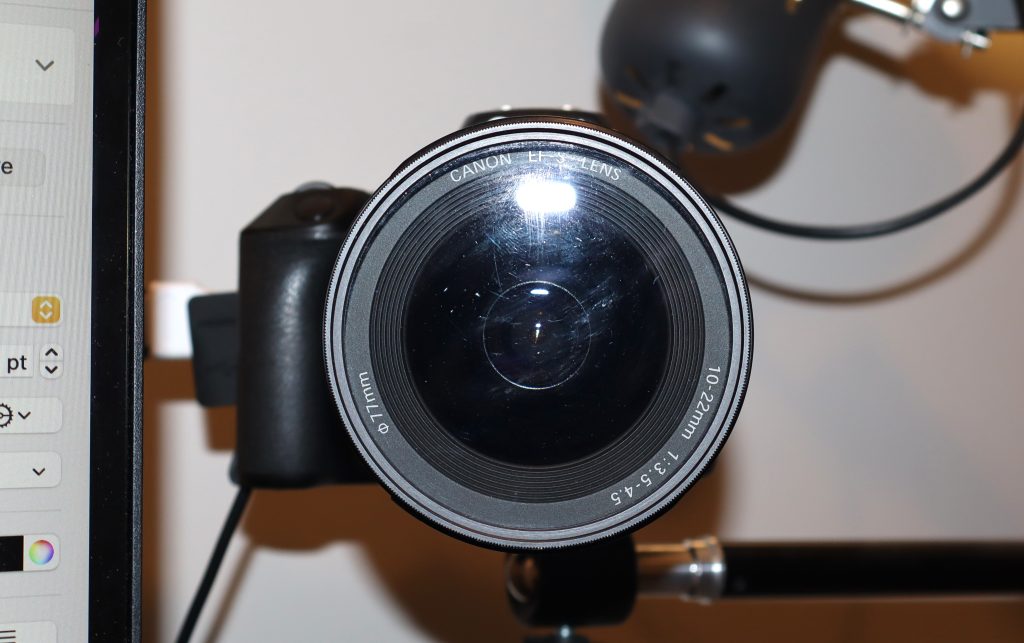
No matter, back to the inter webs I went and discovered that I needed a lens with a smaller focal length, ideally around 18 mm. At this time, I finally decided that I needed a better camera, ideally with autofocus in video mode, so I went back to Facebook bazaar and found a Canon SL3 for $ 400. This is a 2019 model and among the last DSLRs that Canon made. Found hundred Canadian dollarydoos was a lot of money for a webcam but I decided that if I was doing this, I would do it the right way. I then embarked on a quest to find an 18 mm lens and I eventually did find one, an older Canon zoom lens rated for 10 – 22 mm. Good enough for a webcam. This is the set up I still have and it works well. So well that I never move the camera or the capture card or the camera arm. It just sits there as I work. The only thing I do is switch the camera on or off as needed.
You likely noticed the list of equipment in the penultimate sentence there. Yes, I now owned a tripod, a camera arm, an HDMI capture card, two DSLR cameras, four lenses, a dummy battery for each camera. And this was only the start. Eventually, I decided that I liked photography combined with my hobby of fixing things so I bought a “broken” zoom lens, technically a telephoto lens but that word sounds esoteric. Like the word esoteric. The lens wasn’t actually broken, only one of the communication contacts was rusted. I cleaned the rust, cleaned the glass and I had a new lens. I used this to take pictures of birds and my mortal enemies – rats in trees, more commonly known as squirrels.
By this point, I decided that I liked taking pictures that would stand the test of time so I needed a travel camera. I scoured Facebook marktplaats for months, scoffing at the thousand-dollar price tags of used mirrorless cameras. Ah, the mirrorless craze. This meant that many amateur photographers, convinced that the mirror in their camera was the only thing standing in the way photographic greatness, were looking to sell their old camera gear. This is how I found amazing deals on my existing cameras and older Canon lenses. This time, though, I was in the market for a mirrorless camera myself and I was unwilling to pay the high prices they commanded. Eventually, I found a cheap Canon R100 for $ 450. It was small enough that I could carry it everywhere and that is exactly what I did. The internet will tell you that this is a cheap camera for a reason – Canon cut too many corners. No articulating screen, older processor, and so on. It doesn’t matter. It really doesn’t. I primarily set this camera to auto mode, let it do the maths and I just take photos. On Canon’s own website, this model is the #2 or #3 best selling camera.
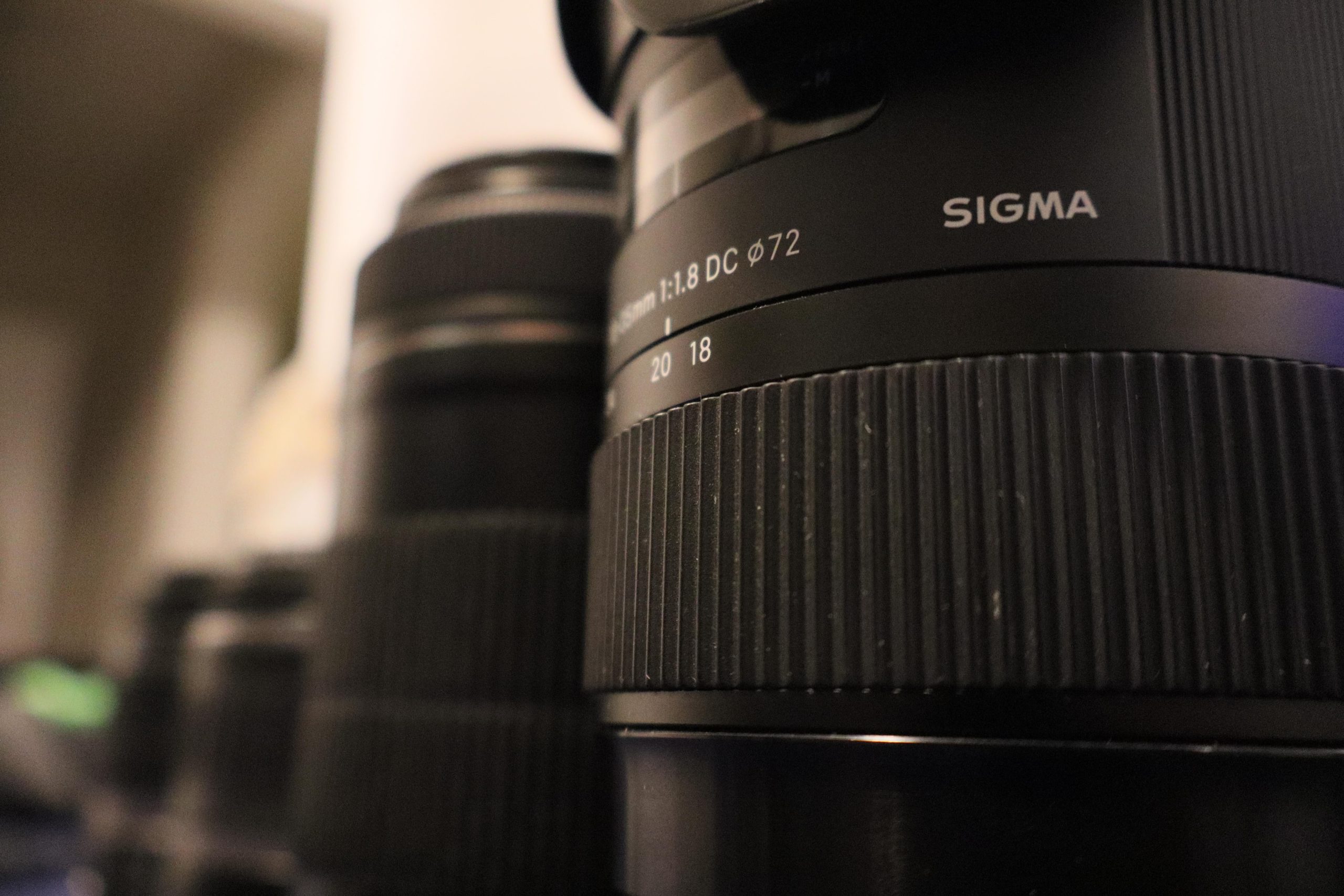
Later, I decided that I wanted to take pictures of the sky (the aurora and the milky way) so I needed a proper lens. “Proper” implies expensive and I eventually bought a Sigma lens for $ 500. The price tag when new was $ 1,300 Canadian dollarydoos. This remains the single most expensive piece of photography equipment I have purchased and I expect that record to hold for at least a few years. When I stood at the CIBC ATM withdrawing cash, I cried a little inside. This lens, however, produces some stunning images. A pity that I don’t know what I’m doing and so I rarely take any stunning images. Still, I can photograph the night sky and a lot of stars, and even the Andromeda galaxy! This brings me joy.
I will conclude with this – yes, your phone can take some pretty amazing images given its compact size. Yes, the best camera is the one you have with you in the moment. But, if you want images that you can print and frame as memories, ones that look like real moments, with real people, with imperfect faces, you should buy a real camera. I have many images saved over the years. When I recently printed a few, every single image from my various phones looked like rubbish. Why? Either the resolution was too low or the “computational photography” produced weird skin tones, strange patterns or just a blurry mess as the computer tried to guess what reality looked like. I don’t care if the Google or Apple engineers produced an AI model that guesses accurately. I don’t want a guess, I want reality. My skin isn’t perfect, neither are my teeth and my photography skills are far from good. But I don’t care. Auto mode is good enough, but it is only good enough on a real camera.
PS – the table shows the cost of every single piece of camera gear I’ve purchased over the past three years. It adds up to $ 2,095. I am certainly not happy with that amount but I must remind you – Canon will charge you double that for a single RF-mount lens. Not the camera, just the lens. Yes, a very good lens, but still, that’s over $ 4,000 for just one lens. All said, I found some amazing deals and am happy with my purchases. I encourage you to buy a real camera, but buy used. Let someone else take the hit on depreciation.
Canon T3 plus batteries, a camera bag and kit lens
$250
Camera tripod
$20
HDMI capture card (Elgato, 1080p)
$120
Camera arm (desktop)
$35
Canon EF-S 10-22 mm lens
$200
Canon SL3 with kit lens
$400
Canon 55-250mm EF-S zoom lens
$60
Canon EF 50 mm lens (f1.8)
$60
Canon R100 camera with kit lens
$450
Sigma Art lens 18-35 mm f1.8 with an EF-RF mount adaptor
I live in a part of the world with four distinct seasons. One season is winter and winter in Canada is cold. Winter in Ontario is often quite cold. Our house has two halves, one is the original brick structure with terrible insulation (non existent, actually) and the other is an extension built to standards of the 90s so it has some insulation. The extension has insulation but poor HVAC design – there are not enough supply and return lines for air.
The result of this is that my bedroom remains uncomfortably warm in the summer and is too cold in the winter. In 2024, the Feds ran a home retrofit program called Greener Homes and we participated. We received a generous amount of money to swap out our 30 year old furnace and 20 year old AC with a new furnace and a heat pump. This is a dual-fuel system, similar to a Toyota Prius, but without the limit on battery capacity. I can choose to heat my home with either electricity or methane depending on conditions.
This is certainly more efficient than our previous situation but the truly efficient solution is to properly insulate the house. I asked around and the cost was six figures. Not something we could afford easily and we were not keen on investing so much money into a seventy year old house. The solution was obvious – a more efficient heating system and so a dual-fuel system it was.
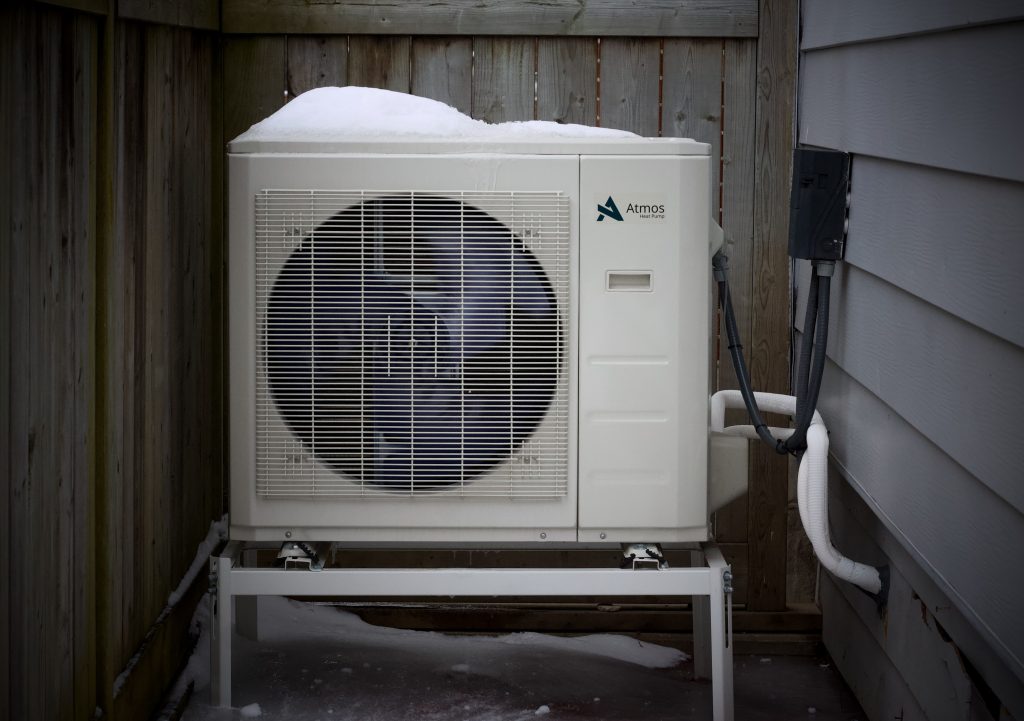
I did my research about which systems NRCan would accept and finally bought a 2.5 ton heat pump from Dettson, which is a rebadged Chinese unit. The internet suggests that Midea is the original brand. The furnace is a standard high-efficiency Trane furnace and we kept our smart thermostat. We run the heat pump in non-communicating mode so it has three operating levels – zero, 50% and 100%. The image at the top is our heat pump in the dead of winter. You can see weeks of ice accumulated under.
All information I had access to said that a heat pump is so much more efficient than a gas furnace that it is often cheaper. Many of these calculations assume a consumer carbon price so they tend to favour electric heating. With the consumer carbon price at zero in 2025, did the heat pump really reduce our gas consumption? I decided to run the numbers and was shocked at the difference it made.
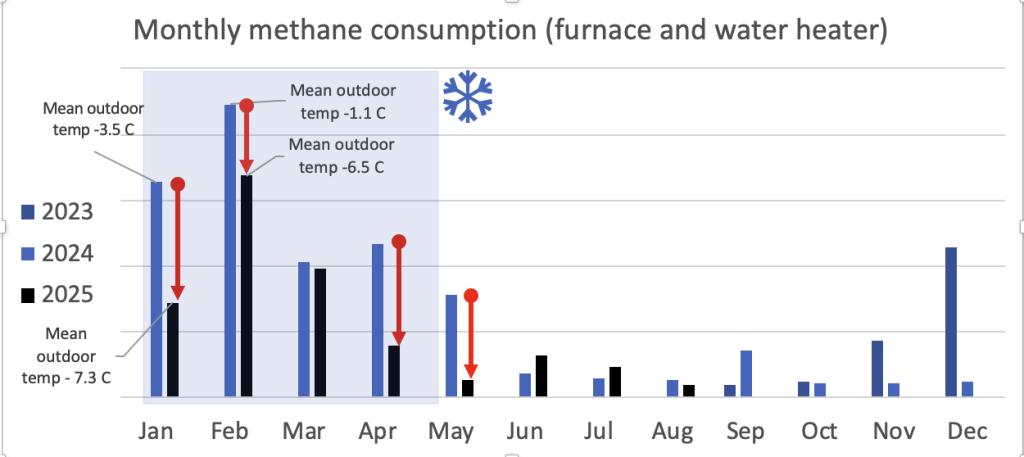
The results are below. Notice the red arrows showing the fall in winter gas consumption. I removed the vertical scale (m3) for privacy reasons but I will repeat – our house has terrible insulation so our gas usage in the winter is relatively high. Despite this, the heat pump put a massive dent in our gas consumption. The winter of 2025 was colder than the winter of 2024. On average, by around 5° C in January and February. Despite this, our gas consumption was down by approximately 60% and we even raised the temperature by 0.5° C indoors. I hoped for a lower bill, but did not expect this reduction. On the coldest days, our heat pump struggled to raise the indoor temperature but it did manage to compensate for the loss of heat through our walls. The gas furnace essentially served to raise the indoor temperature every hour or so, running for about 15 minutes. In years prior, the furnace ran for almost the entire hour, turning off for only about five or ten minutes.
2025-09-06 – Updated to show that the temperatures indicated are mean outdoor temperatures.
I should not be astonished but I still am. I understand how heat pumps work but this still feels like magic. A heat pump is literally an AC with a reversing valve. That’s it. Anyone who tells you that a heat pump doesn’t work in Canada is lying. Ours is rated to – 30° C and I can confirm that it worked well on the coldest day of 2025 – a full 25 degrees Celsius below freezing. A heat pump may not work well on the coldest days in the Canadian prairies but a simple resistive heater will get you through. Better still, keep your gas furnace and do what we did – get a dual fuel system. If the furnace fails, I still have heat. There is a lot of fear mongering from HVAC sales folks who will sell you oversized furnaces and pretend that heat pumps are some magical technology that is bound to fail. Nonsense. Heat pumps work extremely well.
Our heat pump worked so well that we decided to buy a second one. This time, a 1.5 ton ductless system for our bedrooms with two indoor units. This model is from Moovair, also a rebadged Midea unit. It is rated down to – 25 C and works extremely well in the summer. So well that it regularly operates at 30% capacity and keeps our bedroom at a steady 24° C. We will see how it fares in the winter, but I have no doubts that it will work well.
Get a heat pump. If it works in our home, it will work in yours.
Vancouver was the first city I visited in Canada. According to the Economist, Vancouver is among the world’s most liveable cities. It is easy to see why. At the time, I lived in the Netherlands and visited Vancouver for a reason that would later become very important (my wife). I had never seen North America before and immediately after I stepped off the plane, I saw a woman with her child on a leash. A Canadian woman, travelling back from Amsterdam, had her toddler on a leash.
I associate leashes with animals and human sex acts, not human children. This was already jarring but the visit improved from there. I have since visited Vancouver numerous times and I tremendously enjoy the city. For one, I love the ocean. Yes, Vancouver is not exactly on the open Pacific Ocean but it is close enough. I also love the air. Most cities by open water tend to have clean air. Lately, climate change and wildfires mean that Vancouver’s air is regularly among the most polluted in the world but the rest of the year, it is quite nice.
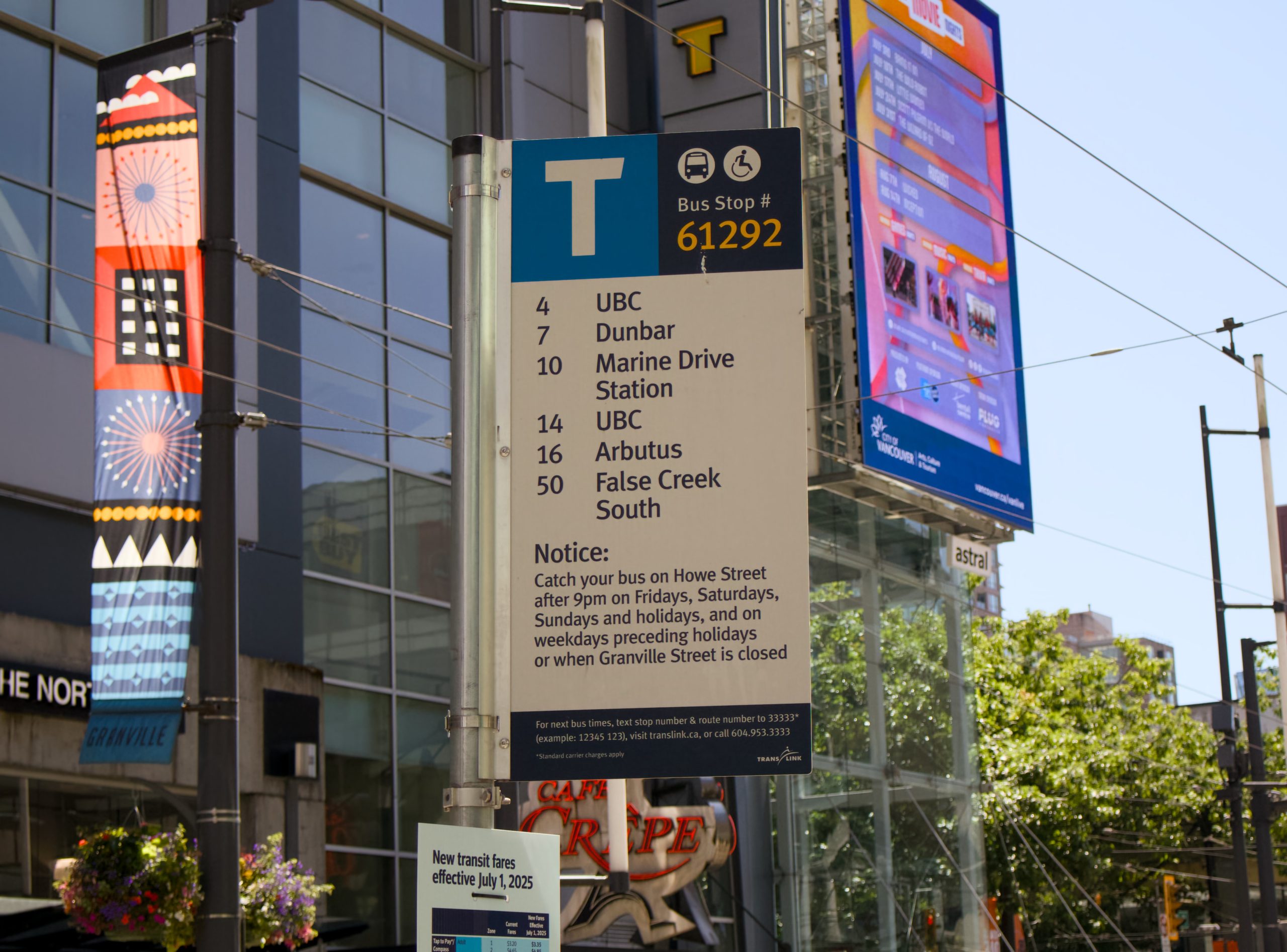
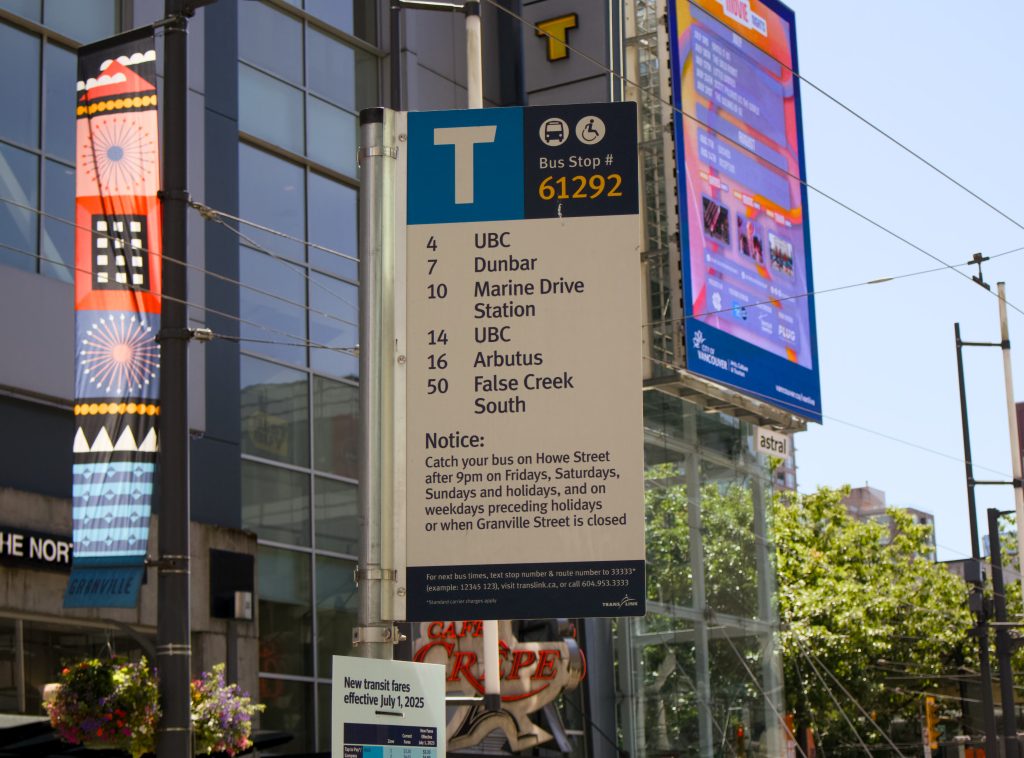
One aspect that I especially like is the public transit. By North American standards, Vancouver’s public transit is amazing. If you live in the city proper, the bus and metro network are excellent. So excellent that you barely need a car. Contrast that with southern Ontario where the entire region is designed around cars and too many people drive vehicles the size of tanks. I feel safer on the Sky Train in Vancouver, with a homeless person nearby than driving along Ontario’s highway 401. Yes, I am inside a climate controlled pod hurtling down the asphalt at 100 km/h, but one wrong move by a danger-loving moron and I could be dead. The worst that is likely on public transit is some homeless person yelling a slur at me. Yes, the homeless problem in Vancouver is significant, innocent people have died and there is a section of the city centre that is largely unsafe, but more than one person dies on Ontario’s highway 401 and you scarcely hear about how monumentally unsafe it is.
I made this point in the past – transit is liberating. Heck, Vancouver’s Sky Trains don’t have drivers and this is technology from the 1980s. That is real freedom. Sitting in the front of a metro train, staring out into the tracks. Some metro stations are extremely well designed. Several Sky Train stations in Burnaby integrate shopping areas, transit and walking paths. That’s how I imagine my ideal life – exit the train, buy groceries and walk home.
People seem to be more active in Vancouver. That could be because the weather is milder or because physical activity offsets some of the crushing problems in the city. One of the most significant is the affordability crisis. Housing in unaffordable. My household is among the top 12% by income but even we would struggle to afford a one million dollar home. And mind, you, a million Canadian dollarydoos gets you into the real estate market in Vancouver, or in less polite terms, you will likely find a house that needs lots of work.
Vancouver’s weather is terrible. Much like western Europe, ocean currents drive warm, moist air towards the poles and this tends to fall as a never ending drizzle. This drains the body and the soul but the humidity is great for plants and wildlife.
On the upside, you can spot lots of wildlife. Blue herons and even dangerous grizzly bears. I do not recommend trying to pet a bear If you see a bear, you avoid it.
Vancouver island is one ferry ride away. The rocky mountains are close by. If you like skiing, the national parks are a couple of hours away. The US is also nearby but I recommend avoiding their brand of freedom lest you find yourself on a detour to a prison in El Salvador.
Would I live in Vancouver? Sure, if I could afford it. I cannot and am unlikely to ever be able to afford it on my income. Inheritances are nice, but do not count. I wonder what will happen to the city in the long term. The pressures of housing and general affordability will drive some people away. Family will push others to stay. I really hope that the city is able to get its act together and increase its density, allowing more young people to move there and stay.
This is a topic with has lots of excellent essays and lots of thought. This is my humble effort.
Public events in Canada generally begin with a land acknowledgement. People acknowledge that the land on which Canada sits is often unceded treaty land. Email signatures include these acknowledgements. Sports games sometimes start with them. Are these just words?
Words can be meaningful. Has the British crown ever issued a full and unconditional apology for the rape, loot and plunder of India? Oxfam estimates that the United Kingdom extracted 65 trillion dollars (in 2025 value) from the Indian subcontinent during the British Raj. Has the British government or crown ever admitted to and accepted responsibility for this? Not to my knowledge. Even if they did simply acknowledge the act, will that be enough? Here is what would be enough for me – acknowledging that the horrors of colonialism happened, accepting that the British government and crown were responsible for it and, finally, asking for forgiveness. These are but words, but they can have an impact. The prosperity of the modern UK is built on stolen wealth. Will that be acknowledged?
A land acknowledgement in Canada, though? Sure, one could argue that it spreads awareness, but awareness of what, exactly? That the land I live on is stolen? But then what?
A fantastic parallel is the caste system in India. I have a caste, every brown person does, but my being Catholic with a Portuguese surname erases one of the most prominent markers of my caste. There are ways to find my caste but my name is not one of them. Caste in India has strong overlap with economic class. Generally, the wealthy are from the upper castes, or maybe a few rungs down, but are rarely from the lower or the disrespected castes. This power has become solidified over generations and is difficult to erode. For example, if I lose all my money, I will be broke. I will never fall into poverty. That, right there, is caste privilege manifesting as an economic safety net. It is likely that the majority of Indians are not upper castes but the upper castes run the country. They have the power.
Imagine a world where caste Hindus acknowledged that their power and influence was built on the exploitation of the lower castes, but that’s it. They simply acknowledged this fact before every public event and then went about their lives exactly as before. Will that demolish the horrors of the caste system and return everyone in the विश्वगुरु (vishwaguru) to a utopia? No.
Caste persists today. It is alive and well despite the feverish denials of many Indians. Land acknowledgements in Canada are similar. Yes, the Indian state has tried to undo millennia of caste privilege by academic reservations for lower caste folks. Has it worked? To an extent but this is not a long term solution. Has the Canadian government made progress towards restoring the rights of indigenous Canadians? Sure, but is it enough? I don’t know. What even is enough?
The way some land acknowledgments are phrased is confusing. I’ve heard some start with “as a visitor on this land…”. I am not a visitor, I live here. You cannot be a visitor and resident at the same time. Maybe I am a visitor in the sense that I will one day be dead?
The settler colonialism phrasing also bothers me. I’ve heard some white people profess a guilt, a feeling of responsibility for colonialism. In my view, there is only one party that bears the full responsibility for Canadian colonialism – the Crown of Canada and therefore, the Canadian government. This, however, is where I differ from crazy people, usually on the political right. White people benefit greatly from colonialism. This is not something in the past tense, it is alive and well today, just as caste is alive and well in India. Just the act of acknowledging caste is difficult for many Indians. Similarly, we cannot simply wish away the colonialism of the past that led to the colonialism of today. Acknowledging it is a good first step but that does not take away from the fact that many land acknowledgements are simply performative, empty gestures. You may benefit from something but you are not responsible for it. The most I ask for is an acknowledgement that a certain system exists.
This brings me back to where I started, is the acknowledgement enough? I don’t know.
Buying a car in Canada in 2025 is a nightmare. The US chicken tax, CAFE regulations and capitalism all combine to mean that small cars no longer exist. Driving a pickup truck the size of a World War II Sherman tank is seen as “essential” and “necessary” because “the boys” will think you’re “gay” if you drive a van. You know, the actually utilitarian vehicle designed to keep your tools locked and out of the elements is somehow a symbol of “unconventional”. Soccer moms “protect” their progeny by buying an “SUV”, that elevates them above the ruddy pedestrians or cyclists, all because the soccer mom’s kids must be safe. If you don’t drive, you are worth less or often, worthless.
What if you do drive and your car is on its last legs? Well, as luck would have it, my 2014 Ford Focus pictured below was in just that situation in 2025. I could hear the clutch rattling every time the computer shifted gears and I was worried that I would soon find myself stuck on the side of a road on a cold night, fumbling with my phone to summon help. This worry was not without reason.
Ford’s 1999 Focus was the European Car of the Year. It was regularly among the best selling cars in Europe, with one caveat – most European models sell with a manual transmission and the Focus was no exception. North Americans are generally less comfortable with a manual transmission and so Ford fitted a shitty rally-style dual-clutch system to the North American models. They took a very well-regarded car and added a fatal flaw to the “automatic” version. This dual-clutch system, in keeping with the car’s general theme, was cheap. Ford cut one too many corners here and used a dry clutch. The exact problem is complicated but manifests as the clutch shuddering i.e. hesitating while accelerating. Despite Ford’s claimed “fixes”, the clutch eventually will break and the car is left undriveable. I had close to 240,000 km on my car (approximately 60% of the average earth-moon distance) and this shudder happened regularly. I learned (pun intended) how to drive around the problem but feared that the end was near.
I needed a new car. What to do?
I looked in all the usual places. Facebook marketplace, car sale websites, dealerships etc. I’m not willing to pay the new car tax but holy gaumata. Prices on new cars are insane. Because of my generally thrifty nature, I decided that an electric vehicle was the appropriate choice. Yes, they are still a hassle in 2025 but the fuel savings are worth it. The cheapest new EV in Canada in 2025 is the Nissan Leaf SV for nearly $ 42,000 [Source – CAA]. New cars were out as I could not afford the prices and I set my budget at $ 25,000, including taxes. This meant that the most I could pay for a car was around $ 21,000. Data from cargurus.ca shows that the average selling price for a used car in Canada increased by approximately 25% between 2020 and 2025. The supply situation is not as dire today as it was during the COVID-19 pandemic but hai ram, cars are expensive.
I shopped around for a used Chevrolet Bolt EV but soon discovered that the prices were low for a good reason – the cars have a reputation for self-combusting. The LG battery packs sometimes encountered a thermal runaway meaning that you just stand there watching the car burn, hoping that no other people are harmed. Chevrolet replaced several battery packs under warranty but the damage was done. The 2023 model was the last until the Americans, dumb as ever, realized that a market for a “compact” (read – realistically sized) car actually exists. The 2023 models were all nearly $28,000 used and were limited to a charging rate of 50 kW. That’s not a problem for daily use but if you ever need to charge the car on the road, you are stuck because charging the battery from 10 % to 80 % takes the better part of an hour. Compare this to more modern EVs such as Hyundai’s Ioniq that can charge at 250 kW so fifteen minutes of fast charging is plenty. Again, the use prices of these cars were outside my budget.
Finding any candidates in this price range was like finding a healthy lion in modern day Europe. Teslas were out because I hate Nazis. Eventually, I did find a Hyundai Kona EV from 2022. The mileage was relatively high for a two year old car but no matter, EV batteries are resilient. I did end up buying that car for around $ 21,000 all included but it did give me pause. My car came from a Ford dealership in Hamilton and my experience was fine. I knew exactly what I wanted, I had a budget and I had the cash on hand. I also knew that an EV has fewer components to fail so crawling under the car answers almost all questions.
A latino couple where ahead of me in the dealership and they just signed off on the loan for a $ 50,000 car. Fifty thousand dollars! How is this normal? Where are the normal sized cars, the cars that can comfortably fit a family of four while being reasonably fuel efficient?
My shitty Ford Focus was very fuel efficient. It had a Japanese-designed engine but the single most important factor was the car’s weight. At just over one tonne, this car was efficient. Surprisingly, a 2025 Hyundai Elantra weighs more than my 2014 Focus but has similar fuel economy. These cars exist but they are expensive. The cheapest Elantra in Canada sells for $ 23,000. My Ford Focus sold for $ 19,000 in 2017. Adjusting for inflation, the prices are almost equal. The lack of options in this range is the problem. Ford no longer sell sedan cars. Neither do Chevrolet. And neither do General Motors. The players in this segment are Japanese, Korean or European. The logic is simple – bigger cars are more profitable. That’s it.
A comparison between my old and new cars. Source – Carsized.com
Never mind the falling safety for pedestrians, never mind the wasted space in the car, never mind the more expensive infrastructure. No, profits matter above all else.
What if you want a small hatchback? You’re often restricted to the used market, where you may find cars like mine, one component failure away from being scrap. Yes, you can buy one of those obnoxious muscle cars and have your neighbours hate you but those are neither cheap nor practical. What if you want an actually large car, like a station wagon? Nope, not for sale on the North American market. The logic then goes that customers don’t buy these models, but how can you buy what does not exist?
My new car is fine. I’m happy it is electric but that comes with a whole learning curve. I dislike the height of the car, I dislike the poor visibility, I dislike that it takes privilege to afford something that enables basic participation in society, something that our entire society is designed around.
I feel for anyone on a budget trying buy a car, any car, in 2025 in Canada.
Winter comes every year. Canada is one of those countries with four distinct seasons. Of these, I can tolerate two, enjoy one but I despise the fourth. Winter. To paraphrase one Gilles, [Ce] pays n’est pas un pays, c’est l’hiver.
Winter is like an icicle, cutting through the joy of the other seasons. This year, the middle of February saw approximately 40 cm of accumulated snow on the ground. Forty centimetres. In some places, it was more. Forty centimetres is enough that our driveway cannot contain it while continuing to function as a driveway. I used my blue shovel to make two neat piles of the stuff, one close to our house and one close to our neighbour’s. I maintained a modest distance between the walls and the snow pile, enough for Jesus to fit in, to ensure that the warm wall did not melt the snow and then refreeze it inside the wall.
There was so much snow that entire cities ran out of space for it. Our street remains unploughed a full two weeks after the Great Snowfall of 2025. This being Canada, the solution is to clear the roads of snow and to dump it on the footpaths so those too poor to afford a car are inconvenienced. That group includes children but clearly, no one will think of the children. If you do not drive, you do not matter.
Meanwhile, many Canadians forget how to drive their cars at the slightest hint of winter weather. Some clowns drive on all-season tires while the really idiotic drive on summer tires. I acknowledge my mortality but I do not want my cause of death to be “did not spend on winter tires”. No, I maintain a set and install them every year on my rickety car. I also drive like an old person so that helps greatly. One morning, while shovelling, I noticed a car in distress, tires spinning helplessly in the snow. I tried to help the driver get his SUV unstuck from the snow until I heard him mention his other “properties”. Until that point, I was willing to ignore the fact that his SUV had summer tires. I wish that man well but will not be surprised if his sport utility vehicle’s chosen “sport” is colliding with a fixed object such as his own house or a rock.
Winter can be an interesting time. Have you observed icicles? Some are clear, some are translucent, some have ridges. I measured the ridges on mine and they are approximately one centimetre apart. According to research [1] at the University of Toronto, this is because of impurities in the frozen water. Of course, a Canadian university funded research into icicles because what else is there to do during a Canadian winter but to wonder about frozen water?
I also built a monument to icicles in our front yard. I realised that the snow pile was two meters high so I broke off a series of icicles and inserted them pointy-side down into the snow, all in a straight line. This action will not make it into the archaeological record but I tried.
Thankfully, winter is now ending and I am eternally grateful to the motion of the earth around the sun that the ambient temperature is now above freezing.
Yes, I hate winter.
[1] Ladan, J. and Morris, S.W., 2022. Pattern of inclusions inside rippled icicles. Physical Review E, 106(5), p.054211.