I live in a part of the world with four distinct seasons. One season is winter and winter in Canada is cold. Winter in Ontario is often quite cold. Our house has two halves, one is the original brick structure with terrible insulation (non existent, actually) and the other is an extension built to standards of the 90s so it has some insulation. The extension has insulation but poor HVAC design – there are not enough supply and return lines for air.
The result of this is that my bedroom remains uncomfortably warm in the summer and is too cold in the winter. In 2024, the Feds ran a home retrofit program called Greener Homes and we participated. We received a generous amount of money to swap out our 30 year old furnace and 20 year old AC with a new furnace and a heat pump. This is a dual-fuel system, similar to a Toyota Prius, but without the limit on battery capacity. I can choose to heat my home with either electricity or methane depending on conditions.
This is certainly more efficient than our previous situation but the truly efficient solution is to properly insulate the house. I asked around and the cost was six figures. Not something we could afford easily and we were not keen on investing so much money into a seventy year old house. The solution was obvious – a more efficient heating system and so a dual-fuel system it was.
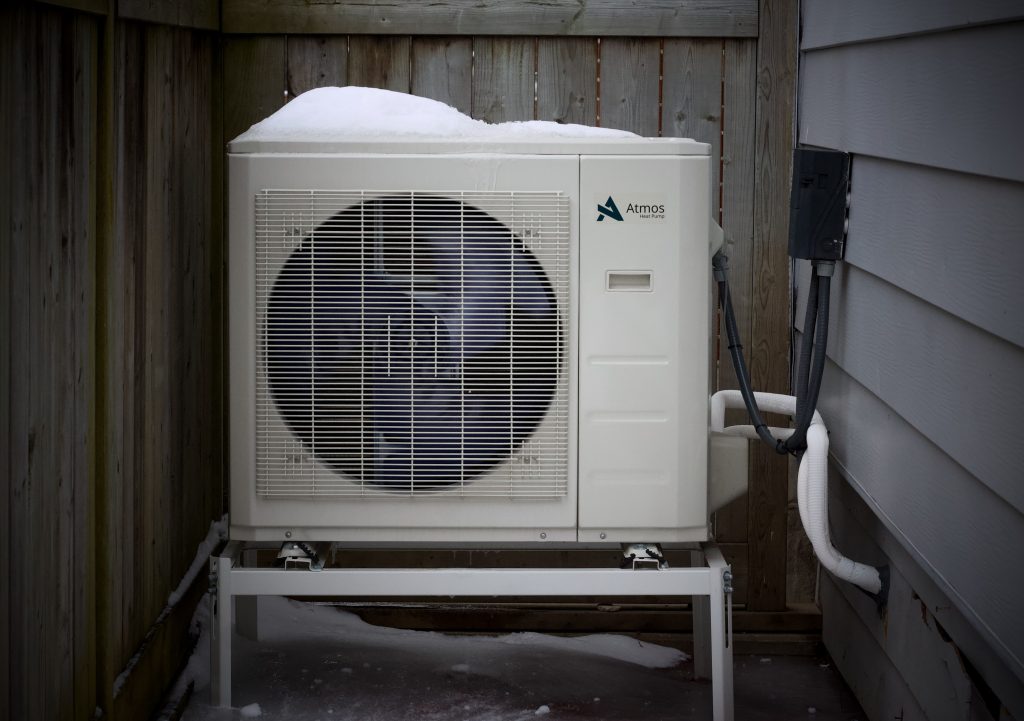
I did my research about which systems NRCan would accept and finally bought a 2.5 ton heat pump from Dettson, which is a rebadged Chinese unit. The internet suggests that Midea is the original brand. The furnace is a standard high-efficiency Trane furnace and we kept our smart thermostat. We run the heat pump in non-communicating mode so it has three operating levels – zero, 50% and 100%. The image at the top is our heat pump in the dead of winter. You can see weeks of ice accumulated under.
All information I had access to said that a heat pump is so much more efficient than a gas furnace that it is often cheaper. Many of these calculations assume a consumer carbon price so they tend to favour electric heating. With the consumer carbon price at zero in 2025, did the heat pump really reduce our gas consumption? I decided to run the numbers and was shocked at the difference it made.
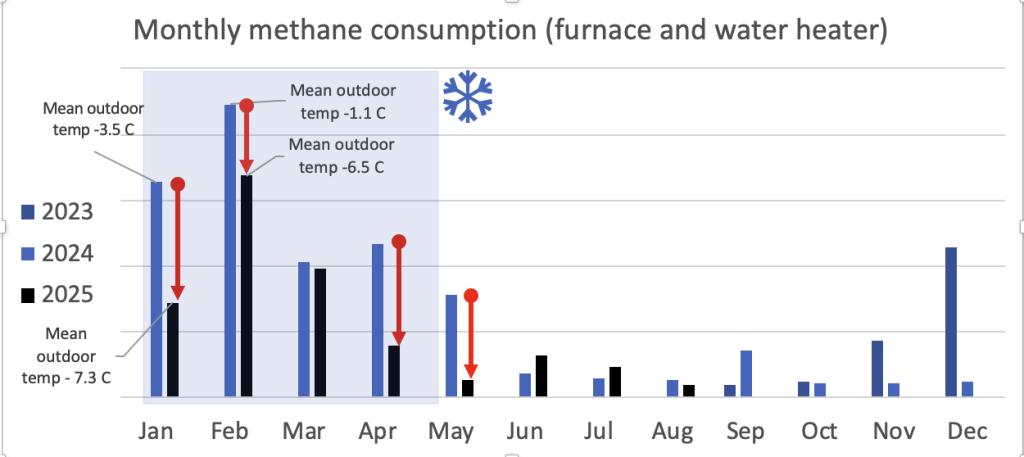
The results are below. Notice the red arrows showing the fall in winter gas consumption. I removed the vertical scale (m3) for privacy reasons but I will repeat – our house has terrible insulation so our gas usage in the winter is relatively high. Despite this, the heat pump put a massive dent in our gas consumption. The winter of 2025 was colder than the winter of 2024. On average, by around 5° C in January and February. Despite this, our gas consumption was down by approximately 60% and we even raised the temperature by 0.5° C indoors. I hoped for a lower bill, but did not expect this reduction. On the coldest days, our heat pump struggled to raise the indoor temperature but it did manage to compensate for the loss of heat through our walls. The gas furnace essentially served to raise the indoor temperature every hour or so, running for about 15 minutes. In years prior, the furnace ran for almost the entire hour, turning off for only about five or ten minutes.
I should not be astonished but I still am. I understand how heat pumps work but this still feels like magic. A heat pump is literally an AC with a reversing valve. That’s it. Anyone who tells you that a heat pump doesn’t work in Canada is lying. Ours is rated to – 30° C and I can confirm that it worked well on the coldest day of 2025 – a full 25 degrees Celsius below freezing. A heat pump may not work well on the coldest days in the Canadian prairies but a simple resistive heater will get you through. Better still, keep your gas furnace and do what we did – get a dual fuel system. If the furnace fails, I still have heat. There is a lot of fear mongering from HVAC sales folks who will sell you oversized furnaces and pretend that heat pumps are some magical technology that is bound to fail. Nonsense. Heat pumps work extremely well.
Our heat pump worked so well that we decided to buy a second one. This time, a 1.5 ton ductless system for our bedrooms with two indoor units. This model is from Moovair, also a rebadged Midea unit. It is rated down to – 25 C and works extremely well in the summer. So well that it regularly operates at 30% capacity and keeps our bedroom at a steady 24° C. We will see how it fares in the winter, but I have no doubts that it will work well.
Get a heat pump. If it works in our home, it will work in yours.