Tag: car

  • One year and one winter with an electric car in Canada

    The conclusion first – it’s fine. Absolutely usable, you barely have to think about it, and it is just a car. I repeat – it is just a car.

    My previous car was on its proverbial last legs in 2025 so I decided that the time was nigh for the switch to an electric car. We bought a used Hyundai Kona EV, the 2022 model, for about 18,000 dollary-doos. We also paid about $ 2,000 to replace our old electric panel and to install and wire an EV charger at home. Technically, this is just a box with a computer and a computer-controlled switch, but everyone calls it a charger anyway.

    We have now lived through a full thirteen months with an electric car, including the famous Canadian winter. How was the experience? Uneventful, except for some learning hiccups. My wife drives to work three days a week so she is the primary user and, as far as she is concerned, this is just a car that happens to plug into the wall. That’s it.

    2026 is a turbulent time, at least geopolitically in the middle least, and that means that the price of petrol has increased significantly. I did the maths last year, and on average, we save about $ 250 per month driving an electric car as opposed to a fuel-efficient alternative. If you drive a lifted pick-up truck and the fuel expenses are starting to hit your wallet… I’m happy. Don’t base your purchasing decision based on the edge case. Base them on your regular usage patterns and the minimum you need. Drive a smaller, fuel efficient vehicle. Pressure your law makers to close the “light” truck loophole and return affordability to vehicles. No one should spend the same as a downpayment on a house for a vehicle. No one. Everyone deserves affordable transit and, while we get there, everyone deserves the choice of an affordable vehicle.

    The Good

    Now that my rant is done, back to the topic. Not paying for petrol meant that our electric bill increased. Yes, we now pay around $ 500* per month for electricity, but that includes running two heat pumps (our house has terrible insulation) and charging the car. On average, we spend around $ 50 per month on electricity for the car, as opposed to an average of $ 400 in the past for petrol. That $ 400 for petrol is now closer to $ 500, considering 2026 prices.

    Aside from the significant fuel savings, the car is just… a car. It is simple, there are fewer parts to break and it generally works as advertised. In general, it remains reliable and the battery longevity is better than expected. The odometer is above 180,000 kilometres and the winter range, even on the coldest days (below – 25 C) is above 300 km. This is almost always sufficient. The heat pump works well and the heated steering wheel is wonderful in the winter.

    *of that $ 500 bill, the Ontario government, led by Dog Ford the Unintelligent, provides a discount of around $ 80. I do not need that discount. You utter imbecile, use that money on schools and hospitals, not discounts for the rich. The “Dog” here is not a typo.

    The bad

    Okay, so electricity is cheap and driving an electric car saves you money. What about the downsides?

    Well, there are several. Hyundai enshittified this car’s software so that the only way to run the cabin heating while plugged into the wall is via a shitty app on your phone or via Hyundai’s website. In other words, there is no technical reason why you cannot run the heating from the wall, Hyundai only allow that to happen via their control. I initially disconnected the car from the internet but then restored the internet connection because we needed a way to heat the car every winter morning. On most days, this is unnecessary because the car has sufficient range, however, when the ambient temperature is -25 Celsius, those ten minutes of heating using electricity instead of the battery significantly reduce the energy used from the battery for heating. Yes, the hardware to run the heat pump straight from the wall exists, but Hyundai, in their infinite capitalist wisdom, cripple the software so you cannot run it from the wall. Instead, if you use the key fob to turn on the climate remotely while connected to a charger, only the fan turns on, not the heat pump compressor. Thankfully, the internet connection and the app do not require payment, for now.

    The scheduled climate function works only when the car is actively charging. Yes, you can set a scheduled departure time and target cabin temperature, but if the car is not charging at that time, the climate control does not run. Enshittification strikes yet again. As a minor aside, the car has needlessly high ground clearance, all in the name of looking “aggressive”. The “aggressive” shape also means that the usable trunk space is smaller than most sedans.

    The real problem is the charging situation when you are out and about and the unreliability of the range meter. One time in the winter, my wife drove to a work event, left the car unplugged overnight and returned the following morning to a range estimate that was uncomfortably close to the driving distance back home. What to do? Find a charger, of course, charge for ten minutes, and drive away. This turned into a hassle because the Tesla (pain be upon the Nazi) charging station was snowed in and the chargers that were accessible did not work. She then drove to the next charger only to find them also not working. As luck would have it, the car did have enough charge to get her home, but guessing the range in winter is not a reliable strategy. She arrived home anxious and annoyed.

    In fairness, this is down to charging infrastructure not being up to scratch in many locations, but that is the incomplete world in which we live. The simple answer is to allow cars to charge at one or two kilowatts at everyone’s workplace, but that is currently not possible. Hence it is a pain.

    The bottom line – should you buy an electric car?

    An EV is a hassle. Don’t let anyone tell you otherwise. The question is how much hassle it is for you and how much of that hassle you are willing to deal with. If you already have more than one car and live in a detached home, you should buy an EV. In fact, you must, simply because it is a prudent financial decision. If you do not have reliable access to a charger, don’t buy an EV. We are not yet there.

    If regular road trips in the Canadian winter are a regular feature of your life, don’t buy an EV. Your three hour trips will turn into four hours at a moment’s notice.

    For the vast majority of people, though, an EV is worth the hassle.


  • How my driving experience changed with an electric car

    In Spring 2025, I bought an electric car. The clutch in my old Ford Focus was on the verge of disintegration. The Americans, clever as always, stopped manufacturing “small” cars and now focus exclusively on suburban assault vehicles like SUVs and pickup trucks, driven by suburban owners of assault rifles and connoisseurs of freedom. A Marxo-socio-communist like me has no option other than to buy a bulbous “crossover” vehicle. These vehicles combine the impracticality of SUVs with the small footprint of a sedan car, producing a true combination of the worst of both worlds. Ah, the American auto industry, truly the most intelligent people on the planet.

    Anyhow, I now drive a 2022 Hyundai Kona EV. It is very cheap to operate and has slashed our petrol spending by 88%. It has buttons, knobs, glass mirrors and is for all practical purposes, just a normal car. I repeat, it is just a car that you drive. There are, however, several niggles that I do not like.

    One obvious difference is in the weight of the car. My old Ford focus weighed around one tonne. This Kona weighs around 2.2 tonnes. The difference in inertia is instantly obvious when braking. The EV takes longer to slow down and the brakes are very aggressive. Something to be aware of, but something that familiarity will fix.

    I like to watch the heads of my passengers as I drive. The forward and backward movement of their heads is a reliable indicator of how much acceleration is happening and I like to minimize acceleration. This means changing speed slowly and consistently. In a combustion car, if you accelerate to highway speeds and then idle the engine, friction makes the car decelerate, but slowly. You can bring the car to a complete stop from 120 km/h in about 200 meters. This is safe and comfortable. In our Hyundai, if you stop accelerating, the car starts braking. This is the action of the regenerative brakes and I appreciate their ability to capture wasted energy. Comfortable, however, they are not. Traffic speed constantly changes and sometimes, you want to stop accelerating but not start braking. You want to coast. That is not easy to achieve in a Hyundai EV. Yes, you can disable the auto regen braking but it has an annoying tendency of turning itself back on. This means that your passengers are quite uncomfortable after a while of constantly swapping between braking and accelerating.

    On the plus side, Hyundai’s adaptive cruise control is very adept at varying engine power to reduce speed and maintain a safe distance to the vehicle ahead. Varying engine power via the accelerator pedal is not as easy.

    On the negative side, cruise control also enables lane detection, which, isn’t always the best. I learned to drive in the Netherlands where skidding on wet and icy roads is a risk. You learn how to drive using a racing line, not for speed, but for safety. Put simply, your car’s tires have finite grip. Changing speed or direction uses grip. In slippery or wet conditions, your aim is to keep the car moving as straight as possible, while also planning for the worst. The racing line starts on the outside curve of a lane, moves to the inside apex and then returns to the outside. You never drive beyond the lane limit. If there is ice, it tends to accumulate on the inside of a banked turn. If your car is already pointing where you want it to go, losing grip on the inside of a turn is less dangerous, you just keep moving ahead safely. Hyundai’s lane assist system will not allow this. It keeps beeping and bonging that the car is too close to the lane edge. Oh and many exits on Ontario highways do not have marked exit lanes. Instead, the right lane becomes wider, with one side becoming the exit ramp. My car keeps trying to force me to exit. You cannot disable lane assist in my car and there is no speed-only mode for the cruise control. Both are linked.

    Hyundai’s “crossover” design for the Kona means that the car is higher than it should be, and so is the hood of the car. In that additional height, is a great big void so the additional height is purely for cosmetic reasons. My strong preference is to not drive into pedestrians, especially children. To maximise front visibility, I use a booster seat. My head now touches the roof of the car and I cannot adjust the rear view mirror at this height. Obviously, this is also a problem if you are tall.

    Hyundai’s software for the car includes scheduled charging, allowing you to minimize your charging costs. This works well. What does not work well is Hyundai’s scheduled departure feature, which is supposed to heat or cool the cabin in anticipation of a fixed departure time. Bizarrely, the scheduled heating/cooling only works if the car is still charging when the departure time arrives. This means that if you depart at 07:00 in the morning and your car just happens to finish charging at 03:00, the departure time is meaningless because the heating/cooling will not run.

    The car includes a liquid cooled battery but there is no way to turn on battery preconditioning. If you are on a road trip, you want the battery temperature to be around 20 C for peak charging speeds, which are already low on a budget car. There is no way to do this. A software update should fix it, but alas. Hyundai appear to be infected by American capitalism.

    The car’s software is also full of beeps and bongs. So many that they are actively irritating and occasionally a safety hazard. Sometimes, the cruise control disengages. That’s a bong. If you use your turn signal in anticipation of a turn and there happens to be a car next to you, that’s a series of beeps. If the outdoor temperature drops to zero Celsius, that’s a bong. If the car ahead of you turns onto a side road, the car’s collision avoidance system thinks that a collision is imminent. That’s a series of bongs. Sometimes, if you brake too hard, the car chides you for dangerous driving. That’s a bong. This is a cultural thing and is evident on other Korean-designed devices like Samsung’s phones, also full of beeps and bongs. I have to try very hard to not train myself to ignore these sounds.

    To be clear, I love an electric car. It does take some getting used to but, nothing time cannot fix. Hyundai have some cultural quirks and some capitalist quirks but give the state of the car market in 2025, I can live with those. I highly recommend the Hyundai Kona, especially if you can find one used.


  • The cost of an electric vehicle in Ontario, Canada

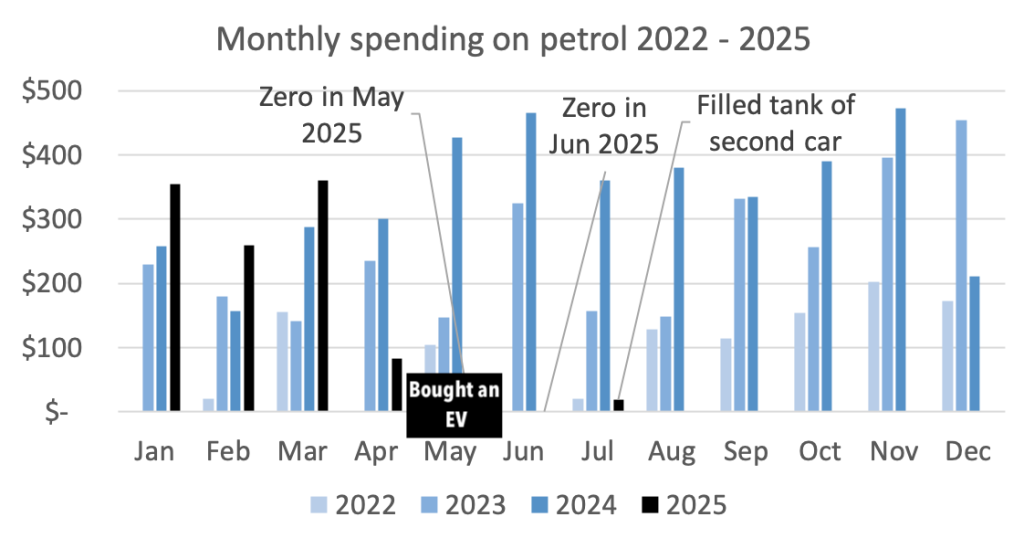
    2025-09-06 – Update – Added a callout to show when we bought an EV. This is what explains the jump in May 2025’s electricity usage.

    I live in a household with two cars. Not by choice. I would prefer to live with zero cars and have excellent public transit but Canada is not the country for that. Not yet. Even in cities like Vancouver or Montreal, transit will only get you so far and you will, eventually, need a car. According to StatCan, 90% of Canadian households own at least one car with over half owning more than one vehicle. That statistic is shameful and I am ashamed to be part of it.

    I view a car as a tool for a job and I will only pay as much as I need to be comfortable. I am not concerned with “dominating” the road or feeling “safe”, hence why my first car in Canada was a four-door Ford Focus sedan. This car had a problem with the dual-clutch system where the clutch would eventually fail. And yes, this was sold as an automatic transmission i.e. a manual transmission where the computer shifted gears. Ford, true to their American capitalist roots, cheaped out on quality and the warranty and only reneged when these issues were taken to the American and Canadian courts. Nonetheless, I owned this car for eight years, between 2017 and 2025 and drove it a lot. So much that when I sold the car, the odometer read over 240,000 km. That is roughly 60% the average earth-moon distance.

    In early 2025, Ford announced that the extended warranty was ending in June 2025 and I decided that the time was nigh. I was in the market for a new car. Since we have two cars, replacing one with an electric car was cheaper in the long run. I had a bit of luck and bought a 2022 Hyundai Kona for 21,000 Canadian dollarydoos, taxes included.

    I’m documenting here the costs of operating an EV. The primary cost is fuel. The chart at the top shows our approximate (incomplete, but mostly complete) spending on fuel. On average, my wife’s commute is long and we spend about one hundred dollars per week on fuel. This amount varied over the years as she changed jobs, had a few work-from-home days, etc. but the general trend holds. Our 2024 monthly average spend on fuel was $ 337, including several weeks when we were away from home and holidays when we drove minimally.

    $100 a week on fuel is a lot, certainly more than the average Canadian. After we bought an EV and switched to using it full time, we went two months with zero visits to a petrol pump. Between May and July 2025, I visited Costco Gas once to fill the tank of our second car, a small Toyota Prius.

    Ok, so we did not consume petrol but an EV still needs “fuel” i.e. electricity. How did that affect our electric bills? The answer – our electric bills increased by about $ 15 per week or approximately $ 60 per month. I will simplify the maths for you – our spending on petrol dropped by $ 100 per week (to zero) while our electricity spending increased by $ 15 per week. A net savings of $ 85 per week or $ 340 per month.

    Yes, a newer car is more expensive to insure and my insurance payments increased by approximately $ 40 per month but despite that, we still came out ahead i.e. we spend less on the car!

    This brings joy to my Indian heart but in true Indian fashion, there is one more variable – the cost of lost interest on the purchase price of the car. At current interest rates (ca. 5% / year), the monthly interest payout on $ 21,000 is just under $ 90. Call it $ 90. This is less than our monthly savings on fuel and insurance.

    Yes, if you account for every expense, an EV costs me approximately $ 250 less to operate each month than my ten year old Ford Focus. On top of this, the old car ran the risk of breaking at any point, possibly while I was far away from home. That’s a risk that is difficult to price. The EV is also cheaper to maintain because I will only pay for tire changes twice a year while the combustion car needed tire changes plus engine oil, oil filters and other fluids that the EV does not use. I do not have that data yet but if you factor it in, the savings are even higher.

    Switching to an EV required some investment such as a new electric panel (not a service upgrade) to accommodate a new charger, and the installation of the actual charger (technically, the EVSE). This added up to approximately $ 3,000, but given our rate of savings, we will cover those costs in one year.

    For anyone interested, we have a smart meter that shows our power consumption in kilowatts. This is important because electrical contractors often claim that 200 A service (48 kilowatts at 240 Volts) is required for an EV and a heat pump. Well, guess what? We operate an EV and TWO heat pumps adding up to 4 tons of capacity. Our maximum power consumption in the summer was 12 kilowatts i.e. half the rated capacity we have now. We have 100 A service which converts to 24 kilowatts and this is more than sufficient. Yes, we cannot run all the burners on our stove and simultaneously charge the car and run both heat pumps at maximum and run the clothes dryer… but is that a realistic scenario? I would much rather encounter the temporary inconvenience of not doing one of those things than have to invest thousands of dollars into a service upgrade that I will never use.

    There are still some unknowns. How long will the EV battery last? I do not know but assuming the battery capacity drops to 90% of the advertised capacity in five years, the drop is not meaningful enough to matter. We will still be able to cover our commutes comfortably. There are unknown benefits as well. We are largely unaffected by the cost of fuel. Our carbon footprint dropped. The consumer carbon price in Canada is zero at the moment so that last benefit does not have a price but it is liberating.

    Should you buy an EV in Canada? Only you can answer that but I will tell you that it is a hassle. The question is how much of a hassle you are willing to accept. You will learn that an indicated range of 300 km is almost always sufficient. You will learn that regenerative braking can be annoying for your passengers. You will learn to deal with the various public charger networks. You may even learn that you do not need a Level 2 charger and that a standard electrical outlet is sufficient for your needs. Does an EV save you money? If you buy used, almost certainly. New EVs are too expensive and too many are needlessly large, have too many “luxury” features and are needlessly complex. Hopefully that changes soon as the Chinese manufacturers will likely show the Americans than consumers do not “prefer” large, aggressive vehicles but instead want practical, value for money cars.


  • Buying a used car in Canada

    Buying a car in Canada in 2025 is a nightmare. The US chicken tax, CAFE regulations and capitalism all combine to mean that small cars no longer exist. Driving a pickup truck the size of a World War II Sherman tank is seen as “essential” and “necessary” because “the boys” will think you’re “gay” if you drive a van. You know, the actually utilitarian vehicle designed to keep your tools locked and out of the elements is somehow a symbol of “unconventional”. Soccer moms “protect” their progeny by buying an “SUV”, that elevates them above the ruddy pedestrians or cyclists, all because the soccer mom’s kids must be safe. If you don’t drive, you are worth less or often, worthless.

    What if you do drive and your car is on its last legs? Well, as luck would have it, my 2014 Ford Focus pictured below was in just that situation in 2025. I could hear the clutch rattling every time the computer shifted gears and I was worried that I would soon find myself stuck on the side of a road on a cold night, fumbling with my phone to summon help. This worry was not without reason.

    Ford’s 1999 Focus was the European Car of the Year. It was regularly among the best selling cars in Europe, with one caveat – most European models sell with a manual transmission and the Focus was no exception. North Americans are generally less comfortable with a manual transmission and so Ford fitted a shitty rally-style dual-clutch system to the North American models. They took a very well-regarded car and added a fatal flaw to the “automatic” version. This dual-clutch system, in keeping with the car’s general theme, was cheap. Ford cut one too many corners here and used a dry clutch. The exact problem is complicated but manifests as the clutch shuddering i.e. hesitating while accelerating. Despite Ford’s claimed “fixes”, the clutch eventually will break and the car is left undriveable. I had close to 240,000 km on my car (approximately 60% of the average earth-moon distance) and this shudder happened regularly. I learned (pun intended) how to drive around the problem but feared that the end was near.

    I needed a new car. What to do?

    I looked in all the usual places. Facebook marketplace, car sale websites, dealerships etc. I’m not willing to pay the new car tax but holy gaumata. Prices on new cars are insane. Because of my generally thrifty nature, I decided that an electric vehicle was the appropriate choice. Yes, they are still a hassle in 2025 but the fuel savings are worth it. The cheapest new EV in Canada in 2025 is the Nissan Leaf SV for nearly $ 42,000 [Source – CAA]. New cars were out as I could not afford the prices and I set my budget at $ 25,000, including taxes. This meant that the most I could pay for a car was around $ 21,000. Data from cargurus.ca shows that the average selling price for a used car in Canada increased by approximately 25% between 2020 and 2025. The supply situation is not as dire today as it was during the COVID-19 pandemic but hai ram, cars are expensive.

    I shopped around for a used Chevrolet Bolt EV but soon discovered that the prices were low for a good reason – the cars have a reputation for self-combusting. The LG battery packs sometimes encountered a thermal runaway meaning that you just stand there watching the car burn, hoping that no other people are harmed. Chevrolet replaced several battery packs under warranty but the damage was done. The 2023 model was the last until the Americans, dumb as ever, realized that a market for a “compact” (read – realistically sized) car actually exists. The 2023 models were all nearly $28,000 used and were limited to a charging rate of 50 kW. That’s not a problem for daily use but if you ever need to charge the car on the road, you are stuck because charging the battery from 10 % to 80 % takes the better part of an hour. Compare this to more modern EVs such as Hyundai’s Ioniq that can charge at 250 kW so fifteen minutes of fast charging is plenty. Again, the use prices of these cars were outside my budget.

    Finding any candidates in this price range was like finding a healthy lion in modern day Europe. Teslas were out because I hate Nazis. Eventually, I did find a Hyundai Kona EV from 2022. The mileage was relatively high for a two year old car but no matter, EV batteries are resilient. I did end up buying that car for around $ 21,000 all included but it did give me pause. My car came from a Ford dealership in Hamilton and my experience was fine. I knew exactly what I wanted, I had a budget and I had the cash on hand. I also knew that an EV has fewer components to fail so crawling under the car answers almost all questions.

    A latino couple where ahead of me in the dealership and they just signed off on the loan for a $ 50,000 car. Fifty thousand dollars! How is this normal? Where are the normal sized cars, the cars that can comfortably fit a family of four while being reasonably fuel efficient?

    My shitty Ford Focus was very fuel efficient. It had a Japanese-designed engine but the single most important factor was the car’s weight. At just over one tonne, this car was efficient. Surprisingly, a 2025 Hyundai Elantra weighs more than my 2014 Focus but has similar fuel economy. These cars exist but they are expensive. The cheapest Elantra in Canada sells for $ 23,000. My Ford Focus sold for $ 19,000 in 2017. Adjusting for inflation, the prices are almost equal. The lack of options in this range is the problem. Ford no longer sell sedan cars. Neither do Chevrolet. And neither do General Motors. The players in this segment are Japanese, Korean or European. The logic is simple – bigger cars are more profitable. That’s it.

    A comparison between my old and new cars. Source – Carsized.com

    Never mind the falling safety for pedestrians, never mind the wasted space in the car, never mind the more expensive infrastructure. No, profits matter above all else.

    What if you want a small hatchback? You’re often restricted to the used market, where you may find cars like mine, one component failure away from being scrap. Yes, you can buy one of those obnoxious muscle cars and have your neighbours hate you but those are neither cheap nor practical. What if you want an actually large car, like a station wagon? Nope, not for sale on the North American market. The logic then goes that customers don’t buy these models, but how can you buy what does not exist?

    My new car is fine. I’m happy it is electric but that comes with a whole learning curve. I dislike the height of the car, I dislike the poor visibility, I dislike that it takes privilege to afford something that enables basic participation in society, something that our entire society is designed around.

    I feel for anyone on a budget trying buy a car, any car, in 2025 in Canada.