
I live in a household with two cars. Not by choice. I would prefer to live with zero cars and have excellent public transit but Canada is not the country for that. Not yet. Even in cities like Vancouver or Montreal, transit will only get you so far and you will, eventually, need a car. According to StatCan, 90% of Canadian households own at least one car with over half owning more than one vehicle. That statistic is shameful and I am ashamed to be part of it.
I view a car as a tool for a job and I will only pay as much as I need to be comfortable. I am not concerned with “dominating” the road or feeling “safe”, hence why my first car in Canada was a four-door Ford Focus sedan. This car had a problem with the dual-clutch system where the clutch would eventually fail. And yes, this was sold as an automatic transmission i.e. a manual transmission where the computer shifted gears. Ford, true to their American capitalist roots, cheaped out on quality and the warranty and only reneged when these issues were taken to the American and Canadian courts. Nonetheless, I owned this car for eight years, between 2017 and 2025 and drove it a lot. So much that when I sold the car, the odometer read over 240,000 km. That is roughly 60% the average earth-moon distance.
In early 2025, Ford announced that the extended warranty was ending in June 2025 and I decided that the time was nigh. I was in the market for a new car. Since we have two cars, replacing one with an electric car was cheaper in the long run. I had a bit of luck and bought a 2022 Hyundai Kona for 21,000 Canadian dollarydoos, taxes included.
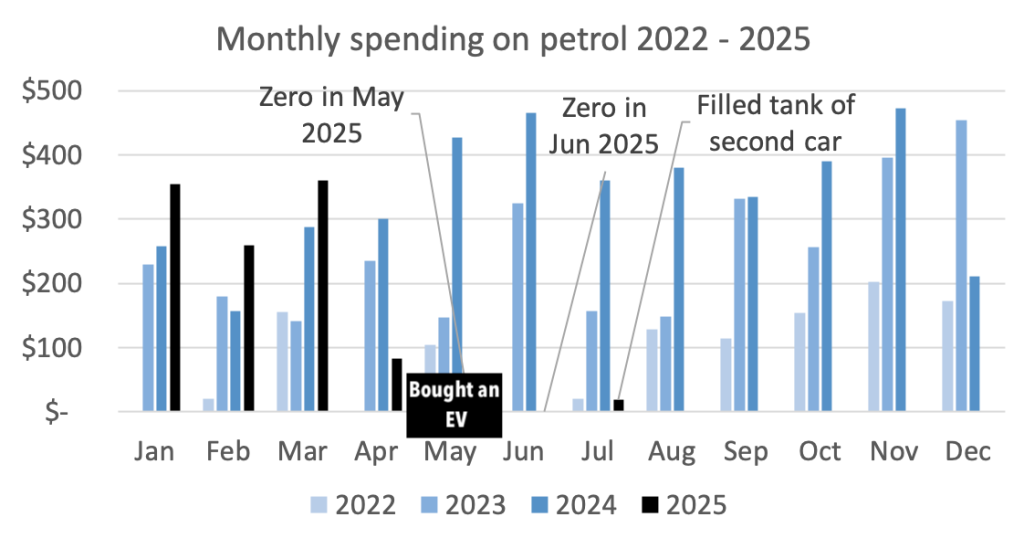
I’m documenting here the costs of operating an EV. The primary cost is fuel. The chart at the top shows our approximate (incomplete, but mostly complete) spending on fuel. On average, my wife’s commute is long and we spend about one hundred dollars per week on fuel. This amount varied over the years as she changed jobs, had a few work-from-home days, etc. but the general trend holds. Our 2024 monthly average spend on fuel was $ 337, including several weeks when we were away from home and holidays when we drove minimally.
$100 a week on fuel is a lot, certainly more than the average Canadian. After we bought an EV and switched to using it full time, we went two months with zero visits to a petrol pump. Between May and July 2025, I visited Costco Gas once to fill the tank of our second car, a small Toyota Prius.
Ok, so we did not consume petrol but an EV still needs “fuel” i.e. electricity. How did that affect our electric bills? The answer – our electric bills increased by about $ 15 per week or approximately $ 60 per month. I will simplify the maths for you – our spending on petrol dropped by $ 100 per week (to zero) while our electricity spending increased by $ 15 per week. A net savings of $ 85 per week or $ 340 per month.
Yes, a newer car is more expensive to insure and my insurance payments increased by approximately $ 40 per month but despite that, we still came out ahead i.e. we spend less on the car!

This brings joy to my Indian heart but in true Indian fashion, there is one more variable – the cost of lost interest on the purchase price of the car. At current interest rates (ca. 5% / year), the monthly interest payout on $ 21,000 is just under $ 90. Call it $ 90. This is less than our monthly savings on fuel and insurance.
Yes, if you account for every expense, an EV costs me approximately $ 250 less to operate each month than my ten year old Ford Focus. On top of this, the old car ran the risk of breaking at any point, possibly while I was far away from home. That’s a risk that is difficult to price. The EV is also cheaper to maintain because I will only pay for tire changes twice a year while the combustion car needed tire changes plus engine oil, oil filters and other fluids that the EV does not use. I do not have that data yet but if you factor it in, the savings are even higher.
Switching to an EV required some investment such as a new electric panel (not a service upgrade) to accommodate a new charger, and the installation of the actual charger (technically, the EVSE). This added up to approximately $ 3,000, but given our rate of savings, we will cover those costs in one year.
For anyone interested, we have a smart meter that shows our power consumption in kilowatts. This is important because electrical contractors often claim that 200 A service (48 kilowatts at 240 Volts) is required for an EV and a heat pump. Well, guess what? We operate an EV and TWO heat pumps adding up to 4 tons of capacity. Our maximum power consumption in the summer was 12 kilowatts i.e. half the rated capacity we have now. We have 100 A service which converts to 24 kilowatts and this is more than sufficient. Yes, we cannot run all the burners on our stove and simultaneously charge the car and run both heat pumps at maximum and run the clothes dryer… but is that a realistic scenario? I would much rather encounter the temporary inconvenience of not doing one of those things than have to invest thousands of dollars into a service upgrade that I will never use.
There are still some unknowns. How long will the EV battery last? I do not know but assuming the battery capacity drops to 90% of the advertised capacity in five years, the drop is not meaningful enough to matter. We will still be able to cover our commutes comfortably. There are unknown benefits as well. We are largely unaffected by the cost of fuel. Our carbon footprint dropped. The consumer carbon price in Canada is zero at the moment so that last benefit does not have a price but it is liberating.
Should you buy an EV in Canada? Only you can answer that but I will tell you that it is a hassle. The question is how much of a hassle you are willing to accept. You will learn that an indicated range of 300 km is almost always sufficient. You will learn that regenerative braking can be annoying for your passengers. You will learn to deal with the various public charger networks. You may even learn that you do not need a Level 2 charger and that a standard electrical outlet is sufficient for your needs. Does an EV save you money? If you buy used, almost certainly. New EVs are too expensive and too many are needlessly large, have too many “luxury” features and are needlessly complex. Hopefully that changes soon as the Chinese manufacturers will likely show the Americans than consumers do not “prefer” large, aggressive vehicles but instead want practical, value for money cars.