Here’s the photographic evidence. All eight of them.
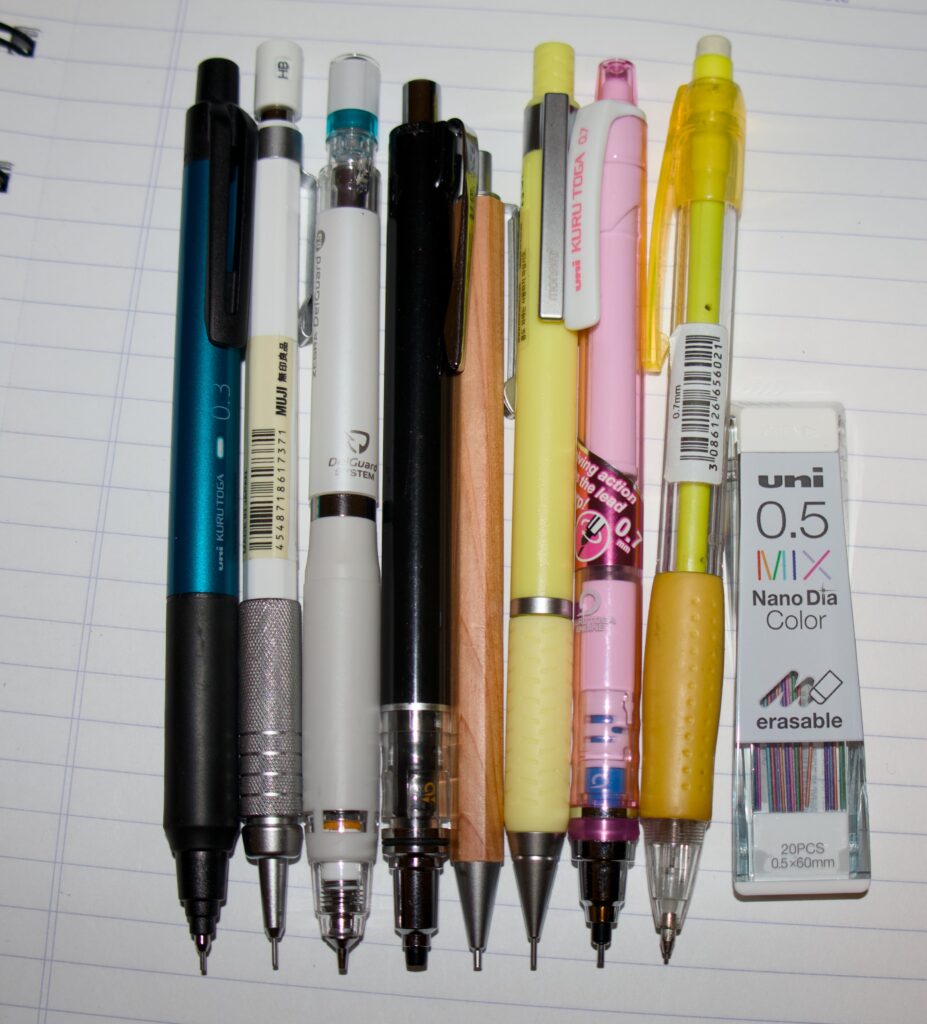
About two years back, I descended down the rabbit hole of Japanese stationery. That led to another rabbit hole of quality stationery products and eventually calligraphy. I now own the full set of Pilot Parallel pens. Yes, my cheap, Indian rear end actually paid full price for these pens and I love them. The mechanical pencils, though, are another matter.
I used mechanical pencils in the past. A cheap Camlin or Bic one. I was always unsure of what the different lead grades were, even after a teacher explained that the letters and numbers refer to a hardness scale. It is difficult to know what you prefer until you try several. A persistent problem I had with mechanical pencils was the lead breaking. I apply a lot of pressure when I write, enough that you can read my writing via the sheet below. I realised only recently that I pressed too hard and that a lighter touch is good for both my hand and the pencil lead.
My quest to find a good mechanical pencil led me to try several options. In the photo above are two pencils from Muji, the Japanese consumer goods store. The first was a 0.3 mm balanced pencil and the second was a wooden body 0.5 mm pencil. I like the feel of the balanced pencil, mostly because of the weight and the metal. The lead was a bit too thin for my liking and fragile as well. I tended to break a lot of new lead because I refiled the pencils via the clutch. I would shove the lead straight up the pointy end while I held the other end down. This is not how you are supposed to refill a pencil. You simply drop a new lead into the barrel and keep advancing until the pencil grabs the new lead from the inside. Anyhow, I broke a lot of 0.3 mm lead.
The second Muji pencil was a wood body 0.5 mm pencil. The body was too narrow and with extended use, my fingers kept touching each other and affected my writing. Not the best.
I then decided to buy the Kurotoga (クルトガ) series from Uni, a truly over-engineered Japanese pencil. These pencils have a rotating clutch mechanism that rotates the lead along the shaft, meaning that the lead wears down evenly. No more variable width strokes! The first pencil was a 0.5 mm version. I enjoyed this so much that I bought a second 0.7 mm one and still use that. On a recent trip to Vancouver, I bought a third, 0.3 mm one – the KS model. These really are amazing pencils and I recommend them to anyone who uses mechanical pencils daily. Not the best for kids as they are relatively expensive, at $ 10 each.
During a trip to Korea (South Korea, of course), I discovered the stationery store Artbox. They carry lots of Japanese pencils and I noticed an anti lead-breaking system pencil – the Delguard from Zebra. Zebra are also Japanese and in the true spirit of Japanese over-engineered pencils, this mechanism also works as advertised. Despite my writing pressure, I am yet to break a single lead with this pencil.
While in Korea, I also bought a Korean-made pencil from Monami. I actually expected Monami to mean something in Korean. It’s just the French mon ami, literally my friend. The Gripix pencil I bought was cheap and excellently built. Nothing fancy, just a reliable mechanical pencil in my favourite colour, yellow. Interestingly, this model has a left handed thread at the top. The eraser advances as you rotate and the eraser itself is relatively long.
Finally, I found a set of coloured lead at Amax stationery in Vancouver’s Metrotown mall. Excellent shop with an even more excellent selection. I love coloured lead because I love adding colour to my notes. Graphite-coloured lead is nice, but what’s life without a splash of colour!
Of the eight mechanical pencils I own, I love the Uni Kurutoga ones. The constant stroke width is nice but I do wonder how these pencils will hold up over the years. I discovered that I enjoy 0.3 mm leads, despite the more scratchy feel on paper. I simply use less pressure. If you are tempted to buy one, I recommend the “advance” models as the metal sleeve can retract into the pencil body. This seems inconsequential at first but that metal sleeve can poke holes in your pencil case or your pockets. The Kurutoga pencils are made in Japan, and I am happy to support Japanese industry.